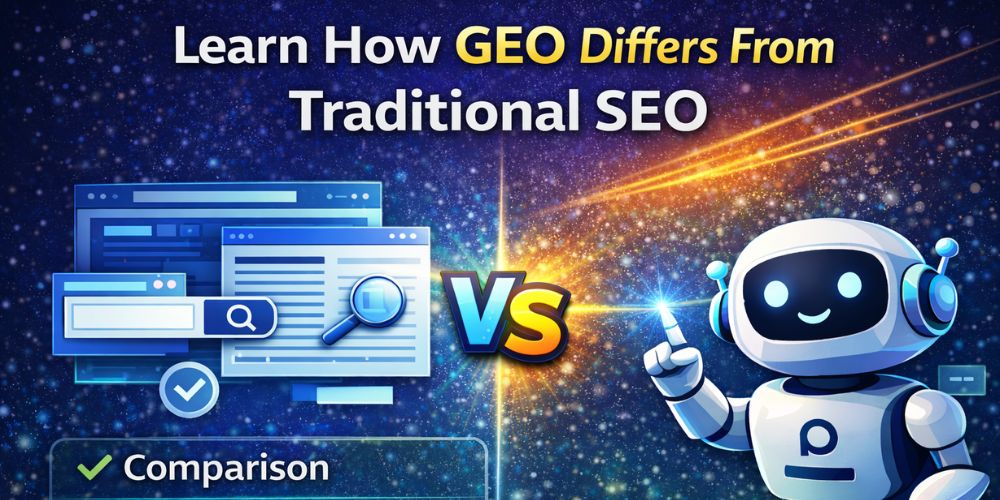
Generative Engine Optimization (GEO) differs from traditional SEO because it focuses on making content usable by AI systems that generate answers, not just rank web pages. SEO targets clicks and rankings, while GEO targets AI understanding, trust, and citations.
What is Traditional SEO?
Search Engine Optimization (SEO) is the practice of improving a website’s visibility in Search Engine results pages (SERPs). It focuses on ranking web pages higher on Search Engines like Google so users click through to the site.
Core SEO elements include Keyword Optimization, Quality Backlinks, Technical Performance, and On-Page Structure.
SEO assumes users will click links to get answers.
What is Generative Engine Optimization (GEO)?
Generative Engine Optimization (GEO) is the practice of optimizing content so AI-powered search engines and generative models can understand it, extract meaning, and reuse it directly in generated responses.
GEO assumes users may never click a link and still consume your information through AI answers.
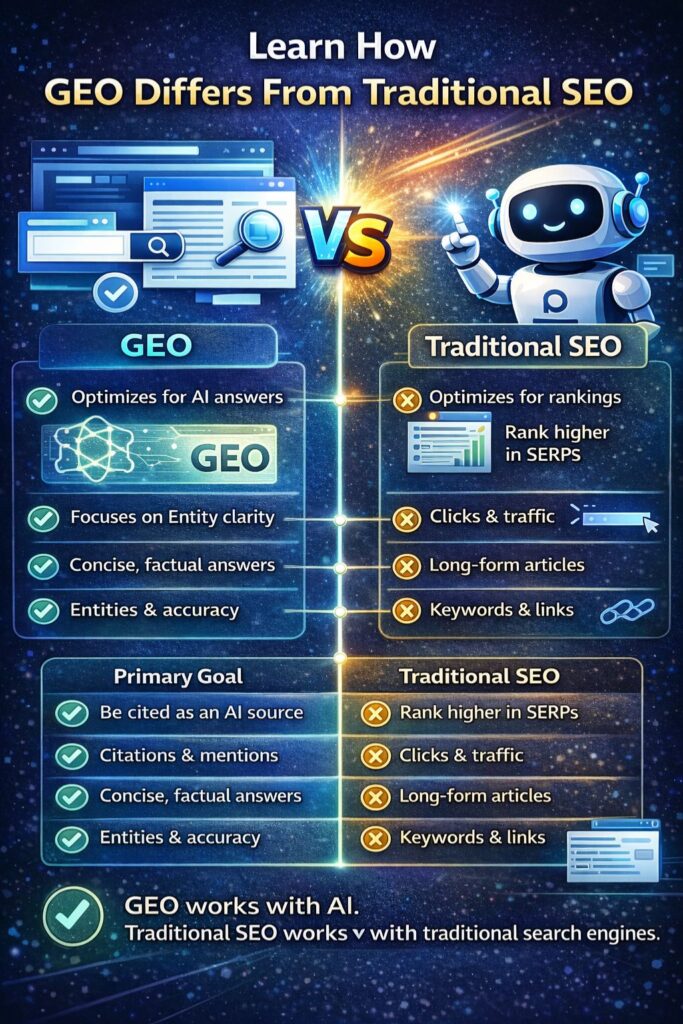
Key Differences Between GEO and Traditional SEO
Core Concept Difference
SEO optimizes for Ranking Pages.
GEO optimizes for Being Referenced as a source.
GEO vs SEO Comparison Table
| Aspect | Traditional SEO | GEO |
|---|---|---|
| Primary Goal | Rank higher in SERPs | Be cited in AI answers |
| Visibility | Click-based | Citation & mention-based |
| Content Style | Long-form pages | Clear, atomic answers |
| Optimization Focus | Keywords & links | Entities & clarity |
| Search Output | Blue links | Generated responses |
| Success Metric | Traffic | AI visibility & trust |
Why SEO Alone is No Longer Enough
With AI Overviews and generative answers:
- Users get answers without clicking
- Rankings don’t guarantee visibility
- AI decides which sources to trust
SEO still helps content get discovered, but GEO decides whether AI uses it.
How GEO and SEO Work Together
SEO provides:
- Crawlability
- Indexing
- Authority signals
GEO ensures:
- Clarity for AI
- Structured answers
- Entity-level trust
👉 SEO brings content into the system. GEO makes it usable inside AI.
When SEO Still Matters More Than GEO
SEO remains critical for:
- Transactional searches
- Local SEO
- E-commerce
- Discovery-based browsing
GEO dominates in:
- Informational queries
- Definitions and comparisons
- “What is / how does” searches
- AI-assisted research
Final Takeaway
GEO does not replace SEO.
It extends SEO into the AI era.
Websites that rely only on rankings will lose visibility, while sites optimized for both humans and machines will win long-term.
FAQs
What is the main difference between GEO and traditional SEO?
The main difference is that traditional SEO optimizes content to rank higher in search results, while GEO optimizes content to be selected and cited by AI systems that generate answers instead of displaying lists of links.
Does GEO replace traditional SEO completely?
No, GEO does not replace traditional SEO. SEO remains essential for crawling, indexing, and authority building, while GEO builds on SEO by making content usable for AI-generated responses and search experiences.
Why are AI search engines changing how content is evaluated?
AI search engines evaluate content based on clarity, structure, and factual reliability because they generate direct answers. They prioritize content that can be confidently summarized, cited, and reused without misinterpretation.
Is ranking still important if AI gives answers directly?
Yes, ranking is still important for discovery and authority signals. However, ranking alone does not guarantee visibility in AI answers, which is why GEO is needed alongside SEO to maintain relevance.
What signals help AI trust content more for GEO?
AI systems trust content that uses consistent terminology, clear entity references, structured headings, neutral tone, and verifiable information. Content that avoids exaggeration and ambiguity is more likely to be reused accurately.
Should businesses invest in GEO now or wait?
Businesses should invest in GEO now because AI-driven search is already influencing visibility. Early adoption helps establish authority, adapt content strategies gradually, and reduce dependency on traditional click-based traffic models.