
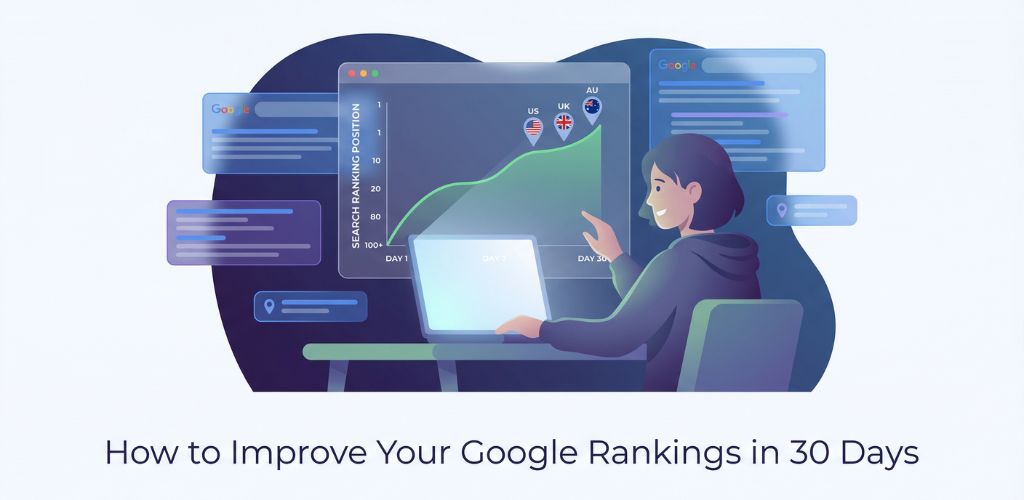
You can improve your Google rankings in 30 days by: fixing basic technical issues (crawlability, speed, mobile), optimizing 5–10 priority pages for clear search intents, upgrading content quality, tightening internal links, and earning a handful of relevant links or mentions. You won’t rank overnight for ultra‑competitive keywords, but you can move the needle on long‑tail queries and under‑optimized pages in a month.
1. Set Realistic Goals Before You Start (Day 0)
Google rewards consistency and quality over hacks. So first, align expectations:
- What you can realistically achieve in 30 days
- Faster indexing and better crawlability.
- Improved rankings for existing pages stuck on page 2–3.
- More clicks from the same impressions (better titles and snippets).
- Early movement for long‑tail keywords like:
- “how to use ai for seo for small business”
- “local seo checklist for restaurants in london”
- “best web design for tradies in sydney”
- What 30 days usually won’t do
- Rank a new domain #1 for “SEO agency USA”.
- Outrank huge competitors with years of authority without serious content and links.
Write down 1–3 specific goals, e.g.:
- “Improve rankings for 5 service pages from page 2–3 into page 1.”
- “Increase organic clicks to our blog by 20% from US/UK/AU.”
You’ll measure against these later.
2. Choose 5–10 Pages to Focus On (Day 1)
Instead of touching every page, pick your highest‑leverage assets:
- Service pages
- e.g. “AI SEO Services”, “Web Design for Local Businesses”, “PPC Management”.
- High‑potential blog posts
- Posts that already get impressions but low CTR.
- Geo‑targeted pages
- e.g. “SEO services for small businesses in Sydney”, “Content marketing for UK SaaS startups”.
How to choose them:
1. Look for pages that:
- Are already indexed.
- Sit around positions 8–30 for relevant keywords.
2. Prioritize those aligned to revenue and target regions (US, UK, AU).
These 5–10 URLs are your “project pages” for the next 30 days.
3. Fix Critical Technical Issues First (Days 1–3)
Even the best content struggles if Google can’t crawl or render your site properly.
Focus on simple, high‑impact checks:
- Indexing and crawlability
- Make sure important pages:
- Are not accidentally set to noindex.
- Are linked from at least one other page (ideally the main nav or hub pages).
- Make sure important pages:
- Check that your robots.txt isn’t blocking key sections.
- HTTPS and mobile‑friendliness
- Your site should:
- Load over HTTPS.
- Be usable on mobile (no tiny text, no horizontal scroll).
- Your site should:
- In many US, UK, and Australian industries, mobile makes up 50–70%+ of traffic.
- Page speed basics
- Compress large hero images.
- Remove unused heavy scripts and plugins where possible.
- Use browser caching and a CDN if you can.
You don’t need to chase perfect scores; just remove obvious bottlenecks so Google and users have a smooth experience.
4. Align Each Page With a Clear Search Intent (Days 3–5)
Google’s helpful content and EEAT guidelines reward pages that match user intent.
For each of your 5–10 pages, ask:
- What is the core intent?
- Informational: “how to improve website speed”
- Commercial: “ai seo services for startups”
- Local: “social media agency melbourne”
- Does the page actually satisfy that intent?
- If the keyword is “how to…”, the page must give a step‑by‑step guide.
- If it’s “[service] agency”, it should look and feel like a service page, not a generic blog.
If you find a mismatch (e.g. a service keyword leading to a thin blog post), either:
- Rewrite the page to match intent, or
- Target a different keyword that fits the current content better.
This “intent alignment” alone can move rankings without any tricks.
5. Upgrade Your On‑Page Optimization (Days 5–10)
Now that intent is clear, improve the way each page communicates with both users and search engines.For each priority page:
5.1. Rewrite Titles for Clarity and Clicks
A good title:
- Reflects the true topic.
- Includes your main keyword naturally.
- Promises a clear benefit.
Examples:
- “AI SEO Services for SaaS Startups in the US & UK | Vix Premium”
- “Local SEO Checklist for Australian Small Businesses (2026 Update)”
- “How to Improve Your Google Rankings in 30 Days (Realistic Checklist)”
Avoid clickbait; aim for honest, specific value.
5.2. Tighten Your H1 and Subheadings
- Use one H1 closely aligned with the title.
- Structure content with descriptive H2/H3s that:
- Break the topic into logical steps.
- Include related keywords in a natural way.
This makes your content skimmable, better for users and for SGE snippet extraction.
5.3. Strengthen Your Introduction (Answer‑First)
For each page, the first 2–4 sentences should:
- State who the page is for.
- State the problem they have.
- Give a short, direct answer or promise.
Example for a UK local SEO page:
> “If you run a local business in the UK, ranking on the first page of Google can be the difference between steady foot traffic and an empty shop. This guide walks you through a realistic 30‑day plan to improve your local rankings using white‑hat tactics only.”
This is AEO‑friendly and SGE‑friendly out of the box.
6. Make Your Content Genuinely Better Than What’s Ranking (Days 10–18)
For each target keyword, search it (incognito) and study the top results in your region (US, UK, AU where relevant). Ask:
- What do they explain clearly?
- What do they miss or only mention briefly?
- Where can your real‑world experience add value?
Then improve your page by:
- Adding missing sections
- Common questions, objections, pricing ranges, checklists, templates.
- Providing concrete examples
- A US SaaS example, a UK agency example, an Australian local business example.
- Including frameworks
- For this 30‑day guide, the “week‑by‑week” structure itself is a framework.
This is where EEAT becomes visible:
- Show your understanding of context and nuance, not just basics.
No need to exaggerate results; authenticity beats hype.
7. Improve Internal Linking and Topical Structure (Days 18–22)
Internal links help Google understand how your content fits together and pass authority between pages.For your 5–10 priority URLs:
- From relevant blog posts, link to them with descriptive anchor text:
- From “how to choose an SEO agency” to your service page using “AI SEO services for small businesses”.
- Create or tighten topic hubs:
- An “SEO Resources” hub that links to all core SEO posts and service pages.
- An “AI Marketing” hub that links to AI blog posts and your AI services.
Make sure internal links are:
- Helpful for users, not just for bots.
- Not over‑optimized: vary anchors naturally (“AI SEO services”, “our AI‑powered SEO approach”, etc.).
Internal links are one of the fastest, safest levers you can pull in under 30 days.
8. Add Clear, Helpful FAQs (Days 20–24)
FAQs are powerful for:
- Answer Engine Optimization (PAA / featured snippets / SGE).
- Addressing objections that block conversions.
For each priority page, add 4–6 specific questions, such as:
- “Can I really improve my Google rankings in 30 days?”
- “How long does SEO usually take for small businesses in the US/UK/Australia?”
- “What are the biggest SEO mistakes startups make?”
- “Should I focus on content or links first?”
Answer in 2–4 sentences each, directly and honestly.Example:
> Can I really improve my Google rankings in 30 days?> You can usually improve rankings for some existing pages and lower‑competition keywords within 30 days, especially if you fix technical issues and update weak content. However, highly competitive terms and new websites typically take several months or more of consistent SEO work to see significant movement.
This style is ideal for SGE and other answer engines.
9. Earn a Few Relevant, High‑Quality Links or Mentions (Days 22–28)
You don’t need hundreds of links in 30 days. A few good, relevant references are more than enough to start.
Focus on:
- Partners and clients
- Ask satisfied clients in the US, UK, or Australia if they can:
- Add you to a “partners” or “recommended vendors” page.
- Mention your guide or checklist in a blog post.
- Ask satisfied clients in the US, UK, or Australia if they can:
- Communities and directories
- Join relevant directories that humans actually use (e.g. niche SaaS directories, design or marketing communities).
- Avoid spammy link farms; they hurt more than help.
- Content promotion
- Share your 30‑day guide and other strong TOFU posts in:
- LinkedIn posts and groups.
- Reddit communities (e.g. r/SEO, r/Entrepreneur, r/smallbusiness), with real value, not just links.
- Local business or startup communities in your target countries.
- Share your 30‑day guide and other strong TOFU posts in:
The goal is to get a few real people to read and reference your content, not to game link metrics.
10. Measure results and plan the next 90 days (Days 28–30)
At the end of the 30 days, compare against your Day 0 baseline:
- Rankings and impressions
- Have positions for your 5–10 pages improved?
- Are you seeing new long‑tail queries?
- Clicks and CTR
- Did your new titles and meta descriptions increase click‑through rates?
- Engagement
- Are users spending more time on your updated pages?
- Lower bounce rates? More scroll depth?
Be transparent about what changed and what didn’t:
- Some pages may jump quickly (especially long‑tail, local search in less competitive niches like regional Australian towns).
- Others might move slowly but steadily.
Use what you’ve learned to plan a 90‑day sprint:
- Publish more TOFU content (how‑tos, examples, glossaries).
- Keep improving existing content based on data.
- Grow your topical authority in your main service areas.
FAQ (short, direct answers)
Can brand‑new websites improve rankings in 30 days?
Yes, but usually only for very low‑competition or branded keywords. For new sites, the first 30 days are best spent setting up strong technical foundations, publishing your first high‑quality articles, and starting to build credibility.
Is it possible to rank #1 fast using grey‑hat or black‑hat SEO?
Sometimes quick wins are possible with manipulative tactics, but they’re unstable and risky. Google’s updates increasingly target spammy link schemes, AI‑generated junk content, and cloaking. For long‑term growth, white‑hat, user‑focused SEO is safer and more sustainable.
Should I prioritize content or backlinks during these 30 days?
For most small businesses and startups, content and on‑page quality are the best first lever. Once your pages are genuinely useful and well‑structured, a small number of relevant backlinks can have a much bigger impact.
Does this 30‑day checklist work for US, UK, and Australian businesses?
Yes. The principles are the same, but competition levels vary by country and niche. Local businesses in smaller Australian cities may see faster movement than businesses in highly competitive US metro areas. Always adapt your expectations to your market.