
Topical authority is no longer optional.
In 2026, Google doesn’t reward websites that publish random, disconnected blog posts. It rewards websites that prove deep expertise in a subject area.
If your traffic is inconsistent…
If your content ranks but doesn’t stay ranked…
If competitors publish fewer articles but outrank you…
You likely don’t have topical authority.
This guide explains:
- What topical authority really is
- How Google evaluates it
- Why it matters more in 2026
- How to build it step-by-step
- Advanced strategic frameworks
- Common mistakes to avoid
This article is written for business owners, startups, agencies, and digital marketers who want sustainable organic growth.
What Is Topical Authority?
Clear Definition
Topical authority is the level of expertise, depth, and comprehensive coverage your website demonstrates on a specific subject.
It’s built by:
- Covering a topic thoroughly
- Structuring content logically
- Answering related questions
- Creating semantic connections between pages
- Demonstrating expertise over time
Search engines like Google evaluate topical authority using signals from:
- Content breadth
- Internal links
- Keyword clusters
- Entity relationships
- User engagement
- Backlinks
In Simple Terms
If Google sees your website as “the expert” on a subject, you have topical authority. If it sees you as “just another blogger writing about random things,” you don’t.
Example
Let’s say you run a website about SEO.
Weak topical authority:
- 1 article about keyword research
- 1 article about backlinks
- 1 article about technical SEO
Strong topical authority:
- Complete keyword research guide
- Keyword research tools comparison
- Search intent breakdown
- Long-tail strategy guide
- Competitor keyword analysis guide
- Content clustering framework
- Entity-based SEO explanation
- Case studies
Which website looks more authoritative?
Why Topical Authority Matters in 2026
Search has evolved—but not just technically. Over the past few years, Google has shifted from keyword matching to context and entity understanding.
Algorithms now use:
- Natural Language Processing
- Entity recognition
- AI-driven ranking systems
- Search intent modeling
With AI features in search (like AI overviews and answer summaries), Google prioritizes content from websites that demonstrate subject mastery, not just keyword usage.
Key Shifts Happening Now
- Rankings are topic-based, not page-based
- Broad niche sites outperform general sites
- Internal linking affects semantic strength
- EEAT signals are stronger than ever
- AI summaries pull from trusted topic hubs
In 2026, a single blog post cannot compete with a structured topical ecosystem.
How Google Evaluates Topical Authority
Google doesn’t use a public “topical authority score.”
However, it evaluates a combination of signals that collectively determine whether your website demonstrates subject mastery.
1. Content Depth
Google analyzes whether your site:
- Covers subtopics thoroughly
- Answers related questions
- Addresses search intent variations
- Connects related concepts
If you write about “keyword research,” Google expects content about:
- Search intent
- Long-tail keywords
- Keyword clustering
- Competitor analysis
- Search volume interpretation
Shallow content signals weak expertise.
2. Semantic Relevance
Google identifies entities such as:
- Search intent
- Keyword clustering
- Content silos
- On-page SEO
- Technical SEO
- Core Web Vitals
If your website covers these in a connected way, it signals authority.
3. Internal Linking Architecture
Internal links tell Google:
- Which pages are most important
- How topics relate
- What the topical hierarchy looks like
Poor structure = weak authority.
4. External Signals
Backlinks from niche-relevant websites confirm your expertise.
Not all backlinks are equal.
A backlink from a digital marketing blog improves SEO topical authority more than a random lifestyle site.
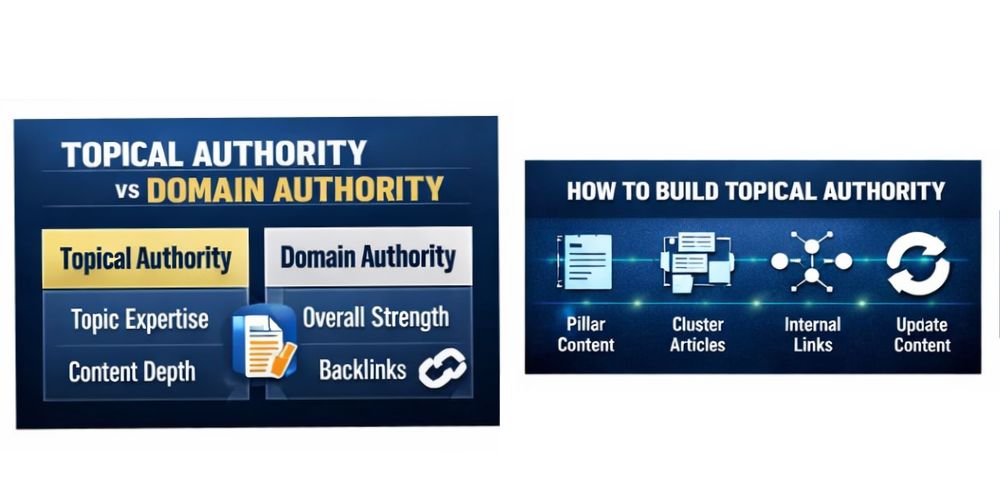
Topical Authority vs Domain Authority
These are not the same and confusing them leads to a poor strategy.
| Topical Authority | Domain Authority |
|---|---|
| Topic-specific expertise | Overall domain strength |
| Built via content depth | Built via backlinks |
| Semantic relevance focused | Link metric focused |
| Topic cluster driven | Domain-wide score |
A small niche site can have strong topical authority even with lower domain authority.
Example: A niche AI SEO blog can outrank a large generic marketing blog when searching for “AI content optimization strategy.”
Step-by-Step: How to Build Topical Authority
This is where most websites fail.
Below is a strategic implementation framework.
Step 1: Choose a Clear Core Topic
Do not try to dominate everything. Choose one primary topic:
- SEO
- AI in marketing
- Local SEO for dentists
- SaaS growth marketing
- E-commerce SEO
Narrow is powerful.
Step 2: Build a Topic Map
Create a master topical map.
Example for SEO:
Core Topic: SEO
Subtopics:
- Keyword research
- Technical SEO
- On-page SEO
- Link building
- SEO tools
- SEO analytics
- Search intent
- Content optimization
Under each subtopic, list:
- Beginner guide
- Advanced guide
- Case study
- Checklist
- Comparison article
- How-to tutorial
This becomes your authority structure.
Step 3: Create Pillar Pages
A pillar page is a comprehensive guide.
It should:
- Be 2,000+ words
- Cover all major aspects
- Link to supporting articles
- Answer related FAQs
- Provide examples
This page becomes your semantic anchor.
Step 4: Create Cluster Content
Each subtopic becomes a detailed post.
Example:
Pillar: Complete Guide to Keyword Research
Cluster posts:
- How to find long-tail keywords
- Competitor keyword analysis
- Keyword difficulty explained
- Search intent types
- Keyword clustering process
Each cluster links back to the pillar.
This strengthens contextual signals.
Step 5: Interlink Strategically
Use:
- Contextual internal links
- Descriptive anchor text
- Topic-relevant linking
Avoid:
- Random blogroll links
- Over-optimized anchor spam
- Broken silo structures
Step 6: Cover the Entire Search Journey
Topical authority requires covering:
- Informational queries
- Commercial queries
- Transactional queries
- Navigational queries
If you only write TOFU articles, authority remains partial.
Step 7: Update Content Regularly
Authority decays if content becomes outdated.
In 2026, freshness matters for:
- SEO tools
- AI trends
- Algorithm updates
- Best practices
Review content every 6–12 months.
Common Mistakes That Kill Topical Authority
Even strong sites fail due to these issues.
1. Publishing Random Topics
If your site covers:
- Crypto
- Fitness
- SEO
- Travel
- Finance
You dilute topical signals.
2. Thin Content Clusters
Five shallow articles ≠ authority.
Depth beats volume.
3. Ignoring Internal Linking
Many websites publish but never structure.
Google sees isolated pages, not ecosystems.
4. Over-Optimizing Keywords
Keyword stuffing weakens trust signals.
Focus on semantic completeness instead.
5. Copying Competitors
Authority requires unique angles:
- Original frameworks
- Real case studies
- Strategic insights
- Implementation breakdowns
Advanced Framework: The Topical Authority Flywheel
Here’s a practical model used by high-growth SEO sites.
Phase 1: Foundation
- Define niche
- Create pillar content
- Build topic clusters
Phase 2: Reinforcement
- Add internal links
- Acquire niche backlinks
- Build supporting examples
Phase 3: Expansion
- Add advanced subtopics
- Publish data-driven studies
- Create comparison assets
Phase 4: Authority Lock-In
- Earn branded searches
- Gain citations
- Appear in AI search summaries
This creates a self-reinforcing loop.
Real-World Example
A SaaS SEO blog publishes:
- 1 pillar on “AI SEO Strategy”
- 8 cluster posts
- 3 case studies
- 1 tools comparison guide
Within 9–12 months:
- Rankings stabilize
- Featured snippets increase
- AI-generated summaries reference their pages
Because they built topic dominance—not random content.
Topical Authority and EEAT
Google emphasizes EEAT:
- Experience
- Expertise
- Authoritativeness
- Trustworthiness
Topical authority strengthens:
- Expertise (depth of coverage)
- Authoritativeness (external validation)
- Trustworthiness (consistent signals)
If you demonstrate real experience and implementation, authority compounds.
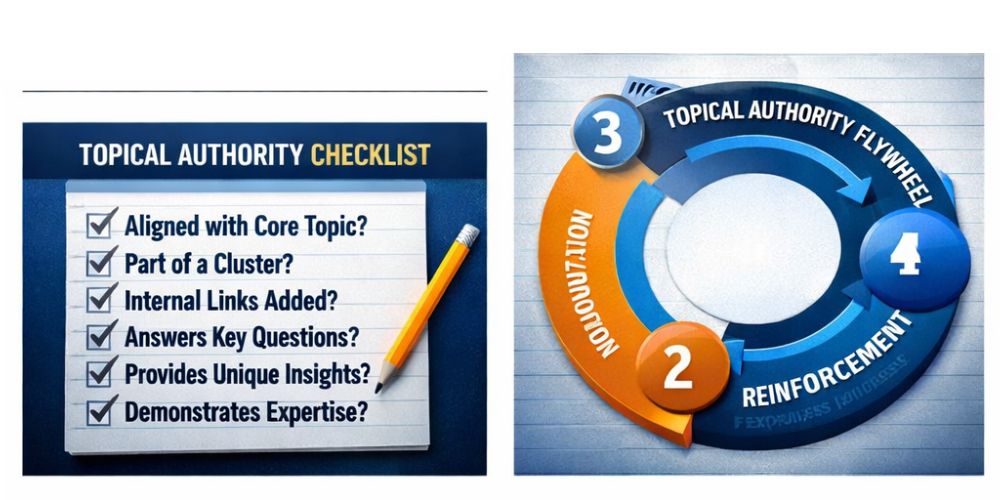
Topical Authority Checklist
Use this before publishing any new content:
- Is this aligned with my core topic?
- Does it connect to an existing cluster?
- Does it link to relevant pages?
- Does it answer related sub-questions?
- Does it add something new?
- Does it demonstrate expertise?
If not, reconsider publishing.
FAQ: What Is Topical Authority?
What is topical authority in SEO?
Topical authority is the level of expertise and comprehensive coverage a website demonstrates on a specific subject, making search engines view it as a trusted source.
How long does it take to build topical authority?
Typically 6–12 months with consistent, structured publishing and internal linking. It depends on competition and niche.
Is topical authority more important than backlinks?
Both matter. However, strong topical authority can outperform sites with more backlinks but weaker content depth.
Can small websites build topical authority?
Yes. Niche-focused sites often build topical authority faster because their content is concentrated around a single topic.
Does topical authority help AI search results?
Yes. AI-driven search systems prioritize structured, authoritative topic hubs for summaries and citations.
Conclusion: Why Topical Authority Is Your Long-Term SEO Asset
Topical authority is not a tactic.
It’s a strategic direction.
In 2026, ranking isn’t about single pages—it’s about building topical ecosystems.
If you:
- Focus on one core niche
- Build structured clusters
- Interlink intelligently
- Demonstrate real expertise
- Update consistently
You create sustainable organic growth.
For businesses, startups, and agencies, this is how you turn content into an asset—not a blog archive.
If you’re planning long-term SEO growth, building topical authority should be your first strategic priority