
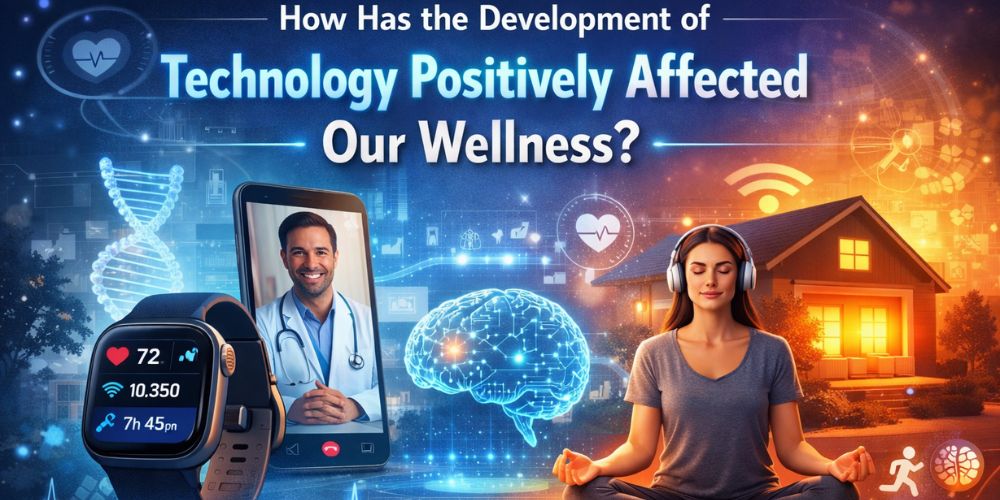
Twenty years ago, improving your health required discipline, memory, and access. You had to schedule appointments, track habits manually, and rely on general advice that wasn’t personalized.
In 2026, wellness has become measurable, accessible, and increasingly proactive.
Smart devices track sleep automatically. Telehealth connects patients to doctors in minutes. Artificial intelligence helps detect disease earlier than traditional screening methods. Meditation apps guide stress reduction in real time.
So when we ask, how has the development of technology positively affected our wellness? — we’re really asking how technology has shifted health from reactive treatment to continuous optimization.
This article breaks it down clearly, strategically, and practically.
What Does Technology-Driven Wellness Mean?
Definition Block
Technology-driven wellness refers to the use of digital tools, connected devices, artificial intelligence, and online platforms to monitor, improve, and maintain physical and mental health.
It includes wearable devices, telemedicine platforms, AI diagnostics, mental health apps, smart home systems, and digital education platforms.
In simple terms:
Technology has made health measurable, accessible, and personalized.
Instead of guessing what your body needs, you now have real-time feedback.
1. Physical Wellness: From Guesswork to Data-Driven Health
One of the most visible impacts of technology is in physical health monitoring.
Wearable devices developed by companies like Apple Inc., Fitbit, and Garmin have turned everyday consumers into informed health participants. These devices measure heart rate, oxygen levels, step counts, calorie expenditure, and sleep quality.
Instead of assuming you slept well, you can analyze sleep stages. Instead of estimating activity levels, you see exact step counts and movement trends.
This continuous measurement has changed behavior. Research consistently shows that people increase physical activity when they track it. The act of seeing data builds awareness, and awareness drives habit change.
Preventative Healthcare Expansion
Technology has also strengthened preventative care.
Artificial intelligence systems now analyze imaging scans, cardiovascular patterns, and risk markers far more efficiently than manual review alone. Institutions such as Mayo Clinic increasingly integrate AI systems for improved diagnostics accuracy.
This results in:
- Earlier disease detection
- Reduced misdiagnosis
- Lower healthcare costs
- Better long-term outcomes
In practical terms, early detection of heart rhythm irregularities or early-stage cancers significantly increases survival rates.
Technology does not replace physicians. It enhances decision-making with precision data.
Telemedicine: Breaking Geographic Barriers
Telemedicine is one of the clearest examples of how technology has positively affected wellness.
Before digital healthcare systems, people in rural or underserved areas faced limited access. Today, patients can connect with licensed professionals through video consultations, receive digital prescriptions, and access follow-up care remotely.
The adoption spike during global health crises accelerated long-term behavioral change. Telehealth is now embedded in healthcare infrastructure.
In simple terms: Access is no longer defined solely by location.
2. Mental Wellness: Scalable Emotional Support
Mental health awareness has expanded dramatically, partly because technology lowered access barriers and reduced stigma.
Platforms such as Headspace and Calm made guided mindfulness accessible to millions. These applications provide structured breathing exercises, sleep guidance, and stress reduction programs.
Instead of attending in-person sessions, users can practice mindfulness daily from their homes. Consistency improves emotional regulation and cognitive resilience.
Digital Therapy and Online Counseling
Online therapy platforms connect users with licensed professionals securely. This has made therapy:
- More convenient
- Less intimidating
- Easier to begin
- More consistent
For many individuals, the hardest part of therapy is starting. Digital systems remove logistical barriers.
AI tools also analyze mood logs and journaling patterns. While they do not replace therapists, they help identify emotional shifts early.
The impact is preventative mental health intervention rather than crisis management.
3. Education and Health Literacy
Wellness improves when understanding improves.
Digital platforms such as Khan Academy, Coursera, and YouTube allow individuals to access credible health education without financial or geographic barriers.
People now learn about nutrition science, sleep optimization, cognitive psychology, and exercise programming from qualified professionals.
In previous decades, misinformation dominated due to limited verification channels. While misinformation still exists, verified institutions and medical professionals now publish accessible educational material online.
In simple terms: Technology improved health literacy at scale.
4. Social and Community Wellness
Wellness is not purely physical or mental. Social connection is equally critical.
Digital communities allow individuals with rare diseases, chronic conditions, or shared wellness goals to connect globally. Support groups now exist beyond local geographic limitations.
Fitness challenges, online accountability groups, and wellness forums create motivation systems that were previously unavailable.
However, technology must be used intentionally. Excessive social media usage can harm mental health. The positive impact emerges when platforms are used for education, support, and meaningful connection.
The tool is neutral. The outcome depends on behavior.
Why This Matters More in 2026
Three macro trends make technology-driven wellness essential.
First, sedentary digital work environments have reduced movement. Remote jobs increase screen time and decrease physical activity. Wearable reminders and structured micro-movements counteract this.
Second, mental health concerns such as burnout and anxiety are rising globally. Scalable digital tools offer low-friction intervention pathways.
Third, aging populations increase healthcare strain. Remote monitoring and AI triage systems reduce pressure on traditional infrastructure.
Technology has transitioned from optional enhancement to foundational wellness infrastructure.
Step-by-Step: Implementing Technology for Better Wellness
Step 1: Establish a Baseline
Before optimizing anything, measure your current state.
Track sleep duration, step counts, resting heart rate, and screen time for seven days. Avoid making changes during this period. The goal is awareness.
Without baseline data, improvement is guesswork.
Step 2: Identify Friction Points
Review your weekly metrics and identify two weak areas. Perhaps sleep averages under six hours. Maybe activity levels remain low.
Focus on priority variables rather than optimizing everything at once.
Clarity reduces overwhelm.
Step 3: Select a Minimal Tech Stack
Avoid downloading multiple tools simultaneously. Instead, select:
- One health tracking device
- One mental wellness tool
- One habit reminder system
Minimalism improves adherence.
Step 4: Implement Micro Adjustments
Rather than drastic changes, adjust gradually.
Go to bed 15 minutes earlier. Add 1,000 additional steps daily. Introduce a five-minute breathing routine.
Small changes compound.
Step 5: Conduct Quarterly Reviews
Every 90 days, review:
- Health metrics
- Mood trends
- Habit sustainability
- Medical check-up status
This transforms wellness into a long-term system instead of short-term motivation.
Common Mistakes in Technology-Based Wellness
One major mistake is over-reliance on apps without behavioral discipline. AI Technology supports action but does not replace effort.
Another mistake is obsessing over daily fluctuations. Health data should be interpreted as trends over time, not single-day results.
Privacy neglect is also common. Users often fail to secure health data properly. Enable two-factor authentication and use verified platforms.
Finally, some individuals replace professional medical advice entirely with digital tools. Technology complements healthcare professionals; it does not replace diagnosis.
Advanced Insights: The Future of Wellness Technology
The next evolution involves deeper personalization.
AI systems will analyze genetic predispositions, environmental exposure data, and lifestyle patterns to generate adaptive wellness plans.
Smart homes will regulate circadian lighting, optimize air quality, and adjust temperature based on sleep cycles.
Neurofeedback and biofeedback devices will train individuals to regulate stress and focus using real-time brainwave analysis.
Wellness technology is moving toward invisibility. It will operate seamlessly in the background rather than demanding constant interaction.
Technology-Enhanced vs Traditional Wellness
Traditional healthcare relied heavily on episodic doctor visits and symptom-driven treatment.
Technology-enhanced wellness operates continuously. Data is collected daily, patterns are analyzed automatically, and feedback loops occur instantly.
Traditional systems were reactive. Modern systems are predictive and preventative.
This shift is perhaps the most meaningful positive effect of technological development on wellness.
Frequently Asked Questions (FAQ)
How has technology positively affected physical wellness?
Technology has improved physical wellness through continuous monitoring, AI-assisted diagnostics, telemedicine access, and personalized feedback systems. Wearable trackers and remote monitoring tools allow individuals to detect irregularities early and maintain consistent health habits based on measurable data trends.
Has technology improved mental health support?
Yes, particularly in accessibility. Digital therapy platforms, meditation applications, and AI-assisted mood tracking have reduced stigma and increased availability of mental health resources. While not replacements for clinical care, they provide scalable early intervention and daily emotional regulation support.
Can wearable devices truly improve health outcomes?
Wearables improve awareness, and awareness influences behavior. By tracking activity levels, heart rate, and sleep quality, individuals gain measurable feedback that encourages consistent habit adjustments. Over time, this leads to improved cardiovascular health, better sleep hygiene, and increased physical activity.
What are the risks of relying on wellness technology?
Risks include data privacy concerns, obsessive metric tracking, and replacing professional medical advice with self-diagnosis. Technology works best as a supportive system alongside licensed healthcare professionals and evidence-based guidelines.
Why is preventative care so important in 2026?
Preventative care reduces long-term disease burden, lowers healthcare costs, and increases life expectancy. With rising sedentary lifestyles and mental health challenges, technology enables proactive habit correction before chronic illness develops.
Conclusion – How has the Development of Technology Positively Affected Our Wellness?
The development of technology has positively affected our wellness by shifting healthcare from reactive intervention to proactive awareness.
It improved physical monitoring, expanded mental health access, enhanced education, and strengthened social connection. It also enabled preventative systems that reduce long-term disease risk.
Technology alone does not create health.
But when integrated strategically, it becomes a multiplier for better decisions, earlier detection, and long-term well-being.
The future of wellness lies in intelligent integration — not elimination — of technology.