Artificial intelligence assistants have rapidly become essential tools for professionals, businesses, and creators. Whether you’re writing content, analyzing research, building software, or automating workflows, AI models can significantly increase productivity.
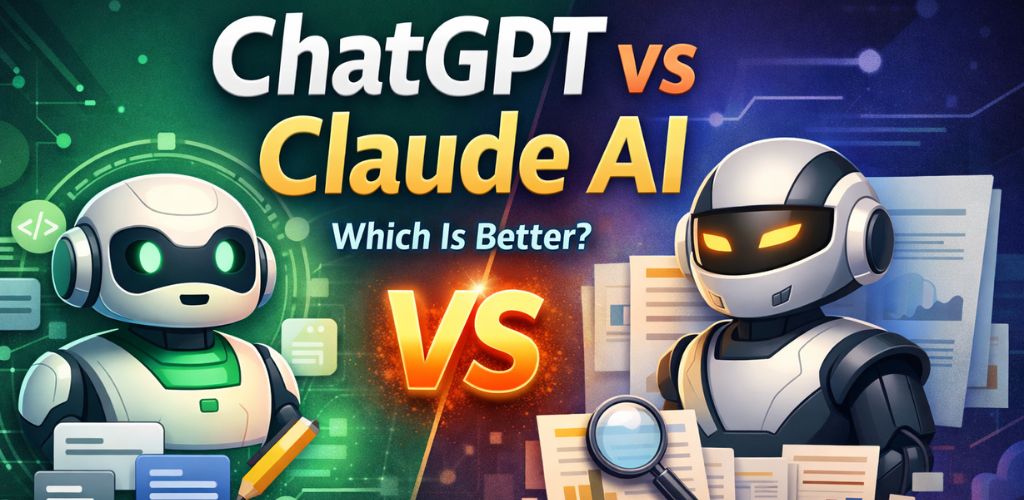
Among the most discussed tools today are ChatGPT and Claude AI. Both are advanced large language models designed to understand natural language, generate responses, and assist with complex tasks. However, their capabilities, strengths, and ideal use cases differ.
For marketers, developers, startups, and content creators, choosing the right AI assistant can directly impact content quality, efficiency, and decision-making.
ChatGPT vs Claude AI: Quick Comparison
Before diving deeper, the table below provides a quick overview of how ChatGPT and Claude AI differ across key areas such as capabilities, ecosystem, and ideal use cases.
This guide provides a detailed comparison of ChatGPT vs Claude AI, including how they work, their features, strengths, pricing differences, and when each tool performs best. We will also briefly compare them with Gemini AI to provide a broader perspective.
| Category | ChatGPT | Claude AI |
|---|---|---|
| Developer | OpenAI | Anthropic |
| Primary Strength | Versatile AI assistant | Deep reasoning and document analysis |
| Best Use Cases | Content writing, coding, automation | Research, analysis, long documents |
| Writing Style | Creative, adaptable | Analytical, structured |
| Coding Support | Very strong | Good but less developer-focused |
| Document Analysis | Good | Excellent |
| Context Length | Large | Extremely large |
| Ecosystem | Large integrations and tools | Smaller but growing |
| Multimodal Capabilities | Text, images, files, tools | Mostly text-focused |
| Popular Among | Marketers, developers, creators | Researchers, analysts, strategists |
What Is ChatGPT?
Definition
ChatGPT is an advanced conversational AI developed by OpenAI. It is based on large language models that are trained on vast datasets to understand language patterns and generate human-like responses.
The tool can perform a wide range of tasks including writing articles, coding, data analysis, brainstorming ideas, summarizing information, and assisting with research.
In simple terms
ChatGPT functions like a multifunctional digital assistant that can help users write, analyze, explain, and automate tasks through natural language conversations.
Key Features of ChatGPT
1. Content Creation and Writing Assistance
One of the strongest capabilities of ChatGPT is content generation. It can write blog articles, social media posts, marketing copy, emails, scripts, and technical documentation.
For content creators and marketers, this ability makes ChatGPT particularly valuable. The model can adapt tone, structure, and formatting depending on the goal, whether the content is designed for SEO, storytelling, or professional communication.
2. Coding and Technical Support
ChatGPT has become widely used by developers because it can write code, explain programming concepts, debug errors, and generate scripts for automation.
It supports multiple programming languages including Python, JavaScript, SQL, and more. Developers often use it to accelerate development, troubleshoot issues, and understand complex code structures.
3. File and Data Analysis
Modern versions of ChatGPT allow users to upload documents, spreadsheets, and datasets. The AI can then analyze the information, extract insights, and provide summaries or explanations.
This feature is useful for business analysts, marketers reviewing campaign data, or researchers working with large documents.
4. Multimodal Capabilities
ChatGPT supports multiple types of input including text, files, images, and sometimes voice interactions. This flexibility allows it to work across a variety of tasks such as interpreting images, analyzing documents, or generating visual content.
Because of this broad capability, ChatGPT often serves as a general-purpose AI assistant.
Pros of ChatGPT
1. Versatility Across Multiple Tasks
One of the biggest strengths of ChatGPT is its versatility. It performs well across many types of tasks including writing, coding, brainstorming, research, and automation. This makes it suitable for professionals in different industries.
2. Strong Ecosystem and Integrations
ChatGPT has a large ecosystem that includes APIs, integrations, and custom AI tools. Businesses can integrate it into applications, websites, and internal workflows to automate tasks or improve productivity.
3. Creative and Marketing-Friendly Outputs
Compared to many AI tools, ChatGPT often produces more creative and conversational outputs. This makes it particularly useful for marketing, content creation, branding, and storytelling.
Cons of ChatGPT
1. Responses May Require Fact-Checking
Although ChatGPT is highly capable, users should still verify important information. Like most AI models, it can occasionally produce inaccurate or outdated responses.
2. Advanced Features Are Paid
While a free version exists, many advanced capabilities such as the most powerful models, file analysis, and integrations are typically included in paid plans.
Also Read: How has the Development of Technology Positively Affected Our Wellness?
What is Claude AI?
Definition
Claude AI is an advanced AI assistant developed by Anthropic. It is designed with a strong focus on reasoning, safety, and long-context understanding.
Claude is particularly well known for its ability to analyze and process very large documents, making it useful for research, policy analysis, and knowledge-heavy tasks.
In simple terms
Claude AI works like a thoughtful research assistant that excels at reading large amounts of information and producing structured insights.
Key Features of Claude AI
1. Long Document Processing
One of Claude’s most distinctive features is its ability to process extremely long documents. The model can read and analyze large reports, academic papers, legal documents, or research materials in a single prompt.
This capability makes it valuable for professionals who frequently work with extensive documentation.
2. Structured Reasoning and Analysis
Claude is often praised for its thoughtful and structured responses. When asked complex questions, the AI tends to break problems into logical components and provide step-by-step reasoning.
This makes it particularly useful for strategy analysis, policy discussions, and research tasks.
3. Safety-Focused Design
Anthropic designed Claude with a strong emphasis on responsible AI behavior. The system is built around principles intended to encourage helpful, safe, and aligned responses.
As a result, Claude may sometimes provide more cautious answers compared to other AI models.
Pros of Claude AI
1. Exceptional Long-Context Understanding
Claude can process much longer prompts than many other AI systems. This means users can provide large documents or datasets and receive detailed analysis without splitting the content into smaller pieces.
2. Strong Analytical Thinking
Claude performs particularly well in tasks that require reasoning, interpretation, or detailed explanation. Researchers and analysts often prefer it when working with complex topics.
3. Clear and Thoughtful Explanations
The model tends to produce structured and carefully worded responses, which can be useful for summarizing complex material.
Cons of Claude AI
1. Smaller Ecosystem
Compared to ChatGPT, Claude currently has a smaller ecosystem of integrations, tools, and third-party applications.
2. Fewer Multimodal Capabilities
Claude focuses mainly on text-based interactions. Although it is highly capable with written information, it currently has fewer multimedia features than some competing tools.
ChatGPT vs Claude AI: Feature Comparison
To better understand how these tools perform in real-world scenarios, it is useful to compare their core capabilities across different categories.
| Feature | ChatGPT | Claude AI |
|---|---|---|
| Content creation | Excellent for blogs, marketing, and creative writing | Good for structured writing and explanations |
| Coding assistance | Advanced coding support and debugging | Capable but not developer-focused |
| Research summarization | Good for summarizing articles and reports | Excellent for large documents |
| Context window | Large context capacity | Extremely large context capacity |
| Reasoning ability | Strong | Very strong |
| File analysis | Supports documents, spreadsheets, and images | Very strong with long text documents |
| AI integrations | Large ecosystem with APIs and tools | Limited integrations |
| Custom AI assistants | Available (custom GPTs) | Limited customization |
ChatGPT vs Claude AI: Performance Comparison
1. Writing and Content Creation
ChatGPT generally performs better when the goal is writing engaging content. It adapts well to different tones and formats, making it suitable for marketing materials, blogs, scripts, and storytelling.
Claude can also generate content, but its style often leans toward analytical writing rather than persuasive or creative marketing language.
2. Research and Document Analysis
Claude often has an advantage when analyzing large amounts of text. It can read long documents and provide well-structured summaries or insights.
For tasks such as policy analysis, research review, or document interpretation, Claude can be particularly effective.
3. Coding and Technical Tasks
ChatGPT is widely used by developers for coding assistance. Its ability to generate code snippets, debug errors, and explain programming concepts makes it valuable for software development workflows.
While Claude can also support coding tasks, ChatGPT generally offers stronger developer-focused capabilities.
4. Ecosystem and Tools
ChatGPT currently leads in ecosystem development. It supports APIs, plugins, integrations, and customizable AI assistants.
Claude is expanding its ecosystem but is still more limited in terms of third-party integrations.
Different AI models excel at different tasks. The table below highlights how each performs across practical use cases.
| Task | ChatGPT Performance | Claude AI Performance |
|---|---|---|
| Blog writing | Excellent | Good |
| Marketing copy | Excellent | Moderate |
| Research analysis | Good | Excellent |
| Coding and debugging | Excellent | Good |
| Document summarization | Good | Excellent |
| Brainstorming ideas | Excellent | Good |
| Strategy explanation | Very good | Excellent |
| Long document review | Good | Excellent |
Pricing Comparison
Pricing structures can change over time, but both ChatGPT and Claude typically offer similar subscription tiers.
Both tools usually provide a free version with basic functionality, along with paid plans that unlock more advanced models and features.
Paid plans generally fall around the same range for individual users, though enterprise pricing varies depending on usage and integration requirements.
Pricing models for AI tools evolve frequently, but the following table reflects the typical structure offered by major AI platforms.
| Plan Type | ChatGPT | Claude AI | Gemini |
|---|---|---|---|
| Free version | Available | Available | Available |
| Paid subscription | Around $20/month | Around $20/month | Around $20/month |
| Advanced models | Included in premium plans | Included in premium plans | Included in premium plans |
| Enterprise plans | Available | Available | Available |
| API pricing | Usage-based | Usage-based | Usage-based |
Where Gemini AI Fits Into This Comparison
Gemini is Google’s AI assistant developed by Google DeepMind. Unlike ChatGPT and Claude, Gemini is deeply integrated with the Google ecosystem.
For users who rely heavily on Gmail, Google Docs, Sheets, and other Google services, Gemini can be particularly convenient. Its strength lies in combining AI with Google’s productivity tools and search infrastructure.
However, when it comes to general-purpose AI workflows, ChatGPT and Claude are often compared more directly.
ChatGPT vs Claude AI: Best Tool for Different Users
The table below summarizes which AI tool works best depending on the user’s goals or profession.
| User Type | Best AI Tool | Reason |
|---|---|---|
| Content creators | ChatGPT | Better writing style and creative outputs |
| Digital marketers | ChatGPT | Strong marketing and SEO content generation |
| Developers | ChatGPT | Advanced coding support |
| Researchers | Claude AI | Strong document analysis and reasoning |
| Analysts | Claude AI | Excellent structured explanations |
| Google Workspace users | Gemini | Deep integration with Google tools |
ChatGPT vs Claude AI: Which One Is Right for You?
Choosing between ChatGPT and Claude AI depends largely on how you plan to use AI in your daily workflow. Both tools are powerful, but they excel in different areas.
If your work revolves around content creation, marketing, coding, or productivity automation, ChatGPT is often the better choice. Its versatility allows users to switch easily between tasks such as writing blog posts, generating business ideas, debugging code, or analyzing files. For creators, startups, and digital marketers, this flexibility makes ChatGPT extremely valuable.
Claude AI, on the other hand, is particularly strong when the work involves deep analysis and long documents. Researchers, analysts, legal professionals, and strategy teams often benefit from Claude’s ability to process large texts and produce structured insights. Its responses tend to emphasize reasoning and clarity rather than creativity.
Another factor to consider is ecosystem support. ChatGPT currently offers a larger set of integrations and customization options, which can be important for businesses building AI-powered workflows.
In many real-world scenarios, professionals do not limit themselves to one tool. Instead, they combine the strengths of multiple AI assistants. For example, a marketer might use Claude to analyze research reports and then use ChatGPT to turn those insights into optimized content.
Ultimately, the best choice depends on whether your primary need is creative productivity or analytical depth.
Practical Implementation Strategy
Businesses and creators increasingly integrate AI into their daily workflows rather than using it for occasional tasks.
A simple implementation strategy could look like this:
First, use AI tools for brainstorming and research. This helps generate ideas, analyze competitors, or explore potential strategies.
Next, use AI to assist with content production, documentation, or coding tasks. This step significantly speeds up execution.
Finally, combine AI insights with human review and strategic thinking. AI works best when it enhances human decision-making rather than replacing it.
This hybrid approach allows organizations to maintain quality while benefiting from automation.
Implementation Checklist for Businesses
For organizations planning to integrate AI tools into their workflow, the following checklist can help ensure effective implementation.
| Step | Action |
|---|---|
| Step 1 | Identify key tasks where AI can improve productivity |
| Step 2 | Choose the primary AI assistant for your workflow |
| Step 3 | Create standardized prompts for recurring tasks |
| Step 4 | Use AI for brainstorming, drafting, and analysis |
| Step 5 | Review outputs with human oversight |
| Step 6 | Continuously optimize workflows using AI insights |
Also Read: Cursor AI: The AI Code Editor That’s Making Traditional IDEs Sweat
FAQ: ChatGPT vs Claude AI
Is ChatGPT better than Claude AI?
Neither tool is universally better. ChatGPT tends to perform better for content creation, coding, and general productivity tasks. Claude AI is often stronger when analyzing large documents and providing structured reasoning.
Which AI tool is best for content writing?
ChatGPT is generally preferred for marketing content, blog writing, and creative storytelling because of its flexible tone and writing style.
Is Claude AI good for research?
Yes. Claude AI is particularly strong at summarizing large documents, interpreting research material, and providing structured analysis.
Can businesses use both AI tools together?
Many organizations use multiple AI tools together. For example, Claude may be used for research analysis, while ChatGPT handles content creation and workflow automation.
Is Gemini better than ChatGPT or Claude?
Gemini is most useful for people who work extensively within Google’s ecosystem. However, ChatGPT and Claude are often preferred for broader AI workflows.
Conclusion
The comparison between ChatGPT and Claude AI highlights an important truth about modern artificial intelligence tools: each system is optimized for different strengths.
ChatGPT stands out for its versatility, creative writing capabilities, coding assistance, and growing ecosystem of integrations. This makes it highly valuable for content creators, developers, and businesses building AI-powered workflows.
Claude AI excels at reasoning, document analysis, and structured explanations. Professionals who work with complex reports or research materials often appreciate its analytical depth.
Rather than viewing the tools as direct competitors, many experts see them as complementary assistants that can be used together to enhance productivity.
As AI technology continues to evolve, understanding the strengths of each platform will help individuals and businesses make smarter decisions about how to integrate AI into their workflows.