
To optimize content for Generative Engine Optimization (GEO), you must write clear, factual, and well-structured answers that AI systems can easily understand, trust, and reuse. GEO prioritizes clarity, entities, structure, and accuracy over keywords alone.
Step 1: Start With Clear Definitions
Every GEO-optimized page should clearly answer:
- What is this?
- Why does it matter?
- How does it work?
Define key concepts in the first paragraph, using simple and neutral language. AI systems often extract these definitions directly.
Step 2: Use One Question Per Section
Each H2 should answer one specific query.
Bad practice:
- Mixing definitions, benefits, and steps in one section
Good practice:
- One heading → one clear answer
This improves AI chunking and retrieval.
Step 3: Write for Entities, Not Just Keywords
Instead of vague references like:
- “this tool”
- “the platform”
Use:
- Exact names
- Consistent terminology
- Clear subject references
Entity clarity reduces ambiguity for generative systems.
Step 4: Use Structured Formats AI Prefers
AI systems favor:
- Tables for comparisons
- Bullet points for steps
- Short paragraphs (2–4 lines)
- Clear headings hierarchy
Avoid walls of text or overly creative formatting.
Step 5: Remove Fluff and Marketing Language
GEO content should be:
- Informational
- Neutral
- Fact-based
Avoid:
- Exaggerated claims
- Vague promises
- Sales-heavy language
AI prefers accuracy over persuasion.
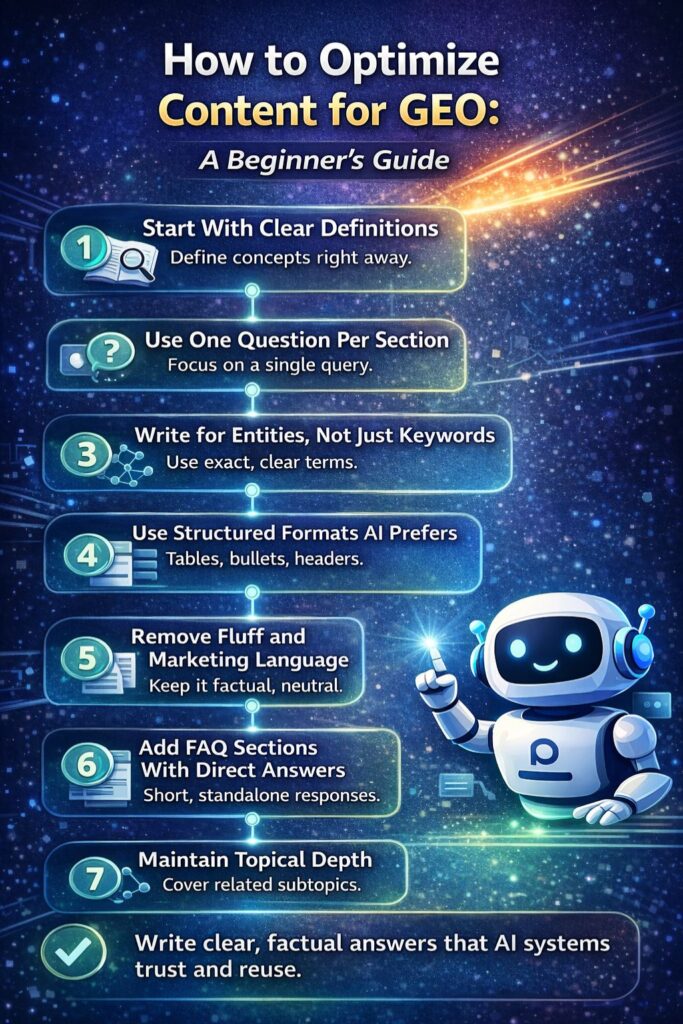
Step 6: Add FAQ Sections With Direct Answers
FAQs help AI:
- Understand common user intent
- Extract short answers
- Reuse content for voice and chat responses
Each FAQ answer should be 30–50 words, factual, and standalone.
Step 7: Maintain Topical Depth
One page is not enough.
To build GEO authority:
- Publish related cluster content
- Interlink conceptually
- Cover the topic from multiple angles
This signals topical trustworthiness to AI systems.
Common Beginner Mistakes in GEO
- Writing long introductions without answers
- Over-optimizing keywords
- Ignoring structure
- Using inconsistent terminology
- Mixing opinions with facts
Is GEO Hard for Beginners?
No. GEO is simpler than SEO once you understand the goal.
Instead of asking:
“How do I rank higher?”
Ask:
“Would an AI confidently reuse this answer?”
Final Takeaway
Optimizing for GEO means writing content that machines can trust as much as humans can understand.
Clear answers, structured formatting, and entity consistency are the foundation of future-proof content.
FAQs
What does it mean to optimize content for GEO?
Optimizing content for GEO means structuring information so AI-powered search engines can clearly understand, trust, and reuse it in generated responses. This involves clear definitions, structured formatting, entity consistency, and factual accuracy rather than keyword-heavy writing.
Is GEO optimization different from SEO optimization?
Yes, GEO optimization focuses on making content usable for AI-generated answers, while SEO focuses on ranking pages in search results. GEO prioritizes clarity, structure, and entities, whereas SEO emphasizes keywords, backlinks, and traffic.
Do beginners need technical skills to optimize content for GEO?
No, beginners can optimize for GEO by following simple writing principles such as answering questions directly, using clear headings, avoiding fluff, and structuring content logically. Technical SEO knowledge helps but is not mandatory for basic GEO optimization.
What type of content performs best for GEO?
Content that performs best for GEO includes clear definitions, comparison tables, step-by-step guides, FAQs, and factual explanations. AI systems prefer concise, well-structured content that answers specific questions without ambiguity.
How long should GEO-optimized answers be?
GEO-optimized answers typically perform best when they are concise and focused, usually between 30 and 60 words. This length allows AI systems to extract and reuse accurate information without losing important context.
Can GEO optimization increase visibility even without clicks?
Yes, GEO optimization can increase visibility even when users do not click your website. Your content may still be cited, summarized, or referenced by AI search systems, increasing brand authority and informational reach.