

Google AI Mode is changing how people search for information, compare products, and explore complex topics. Instead of entering several separate queries and opening multiple websites, users can ask detailed questions and receive AI-generated responses that combine information from different sources.
For businesses and publishers, this development creates an important question: how will websites remain visible when search engines increasingly provide answers directly within their interfaces?
Google AI Mode introduces a more conversational approach to information discovery. It uses AI models, Google’s search infrastructure, and a technique called query fan-out to investigate different aspects of a question before generating a response. Users can also ask follow-up questions, submit images, use voice input, and explore supporting website links.
However, AI-powered search does not make traditional SEO obsolete. Google’s own documentation confirms that established SEO practices remain relevant to AI Overviews and AI Mode. The challenge for website owners is understanding how these experiences work, how they influence organic visibility, and how to measure their impact.
This guide explains Google AI Mode, its features, underlying technology, differences from traditional Google Search, and practical strategies for improving website visibility in AI-powered search.
Key Takeaways
- Google AI Mode is a conversational, AI-powered search experience within Google Search.
- It uses query fan-out to investigate related searches and information sources.
- Users can ask complex questions, submit images and files, use voice input, and continue with follow-up questions.
- AI Mode and AI Overviews serve different purposes, although they share elements of Google’s search infrastructure.
- AI Mode can influence how users discover websites and how organic traffic is distributed.
- Traditional SEO remains essential for technical eligibility and content discovery.
- Original research, expert explanations, accurate information, and strong internal linking support sustainable content strategies.
- Google does not require special AI-specific schema markup or files for inclusion.
- Search Console now offers dedicated reporting for generative AI search visibility.
- Website owners can manage inclusion in supported AI search experiences through Search Console.
- AI search visibility should be evaluated alongside engagement, qualified leads, and revenue.
- Key Takeaways
- 1. What Is Google AI Mode?
- 2. How Does Google AI Mode Work?
- 3. Key Features of Google AI Mode
- 4. Google AI Mode vs. AI Overviews vs. Traditional Search
- 5. How to Access and Use Google AI Mode
- 6. How Google AI Mode Affects SEO
- 7. How to Optimize Your Website for Google AI Mode
- 8. Common AI Search Optimization Mistakes
- 9. How to Measure Google AI Mode Performance
- 10. Google AI Mode and the Future of Search
- Frequently Asked Questions
- Conclusion
- External References
1. What Is Google AI Mode?
Google AI Mode is an AI-powered search experience within Google Search that allows users to ask complex questions, receive synthesized answers, and explore information through conversational follow-up questions.
Traditional Google Search primarily presents a ranked collection of webpages related to a search query. AI Mode takes a different approach by generating a response that combines information gathered from multiple searches and relevant online sources.
For example, someone researching project management software might traditionally perform several searches:
- Best project management software for small businesses
- Asana vs. ClickUp
- Project management software with automation
- Project management tools with reporting features
- Affordable project management software
With Google AI Mode, the user can combine these requirements into one detailed question:
“Compare Asana, ClickUp, and Monday.com for a 15-person marketing agency. Evaluate automation, reporting, integrations, pricing considerations, and ease of onboarding. Explain which platform would be most suitable for a team without dedicated technical support.”
AI Mode can investigate the different requirements and organize relevant findings into one response.
Is Google AI Mode a separate search engine?
No. Google AI Mode is an experience within Google Search, not an independent search engine operating separately from Google’s search infrastructure.
It combines generative AI capabilities with Google’s understanding of web information to respond to more complex information needs. Users can interact with the system through questions, follow-up prompts, and different input formats.
Google describes AI Mode as its most powerful AI search experience, designed for questions requiring additional exploration, reasoning, and comparisons.
Why it matters: AI Mode changes the search interface and the way information is presented, but discovering relevant and useful web content remains an important part of the experience.
2. How Does Google AI Mode Work?
Google AI Mode combines AI-powered reasoning with information retrieved through Google Search. Rather than relying on one search query, it can explore several related questions to develop a more comprehensive response.
The process involves interpreting the user’s request, identifying relevant subtopics, retrieving information, and generating an answer supported by links to websites.
Understanding the user’s question
The process begins when someone enters a question into the AI Mode interface.
Google’s systems interpret the subject, context, intent, and different requirements within the request. A question about choosing business software, for example, may involve pricing, integrations, security, functionality, and usability.
Understanding these relationships helps determine what information needs to be investigated.
Query fan-out: Exploring multiple searches
One of the most important concepts behind Google AI Mode is query fan-out.
Query fan-out is a technique that generates multiple related searches from an original question. These searches investigate different subtopics and information requirements, allowing the system to retrieve a broader range of relevant information.
Consider this question:
“Which electric vehicle is suitable for a family that regularly travels long distances, has a limited charging budget, and needs sufficient luggage space?”
Instead of investigating only one general query, Google’s systems may explore related subjects such as:
- Electric vehicles with longer driving ranges.
- Battery capacity and charging efficiency.
- Vehicle purchase prices and ownership costs.
- Passenger comfort and luggage capacity.
- Charging infrastructure and compatibility.
- Independent vehicle reviews and comparisons.
The system then brings relevant information together to generate a response.
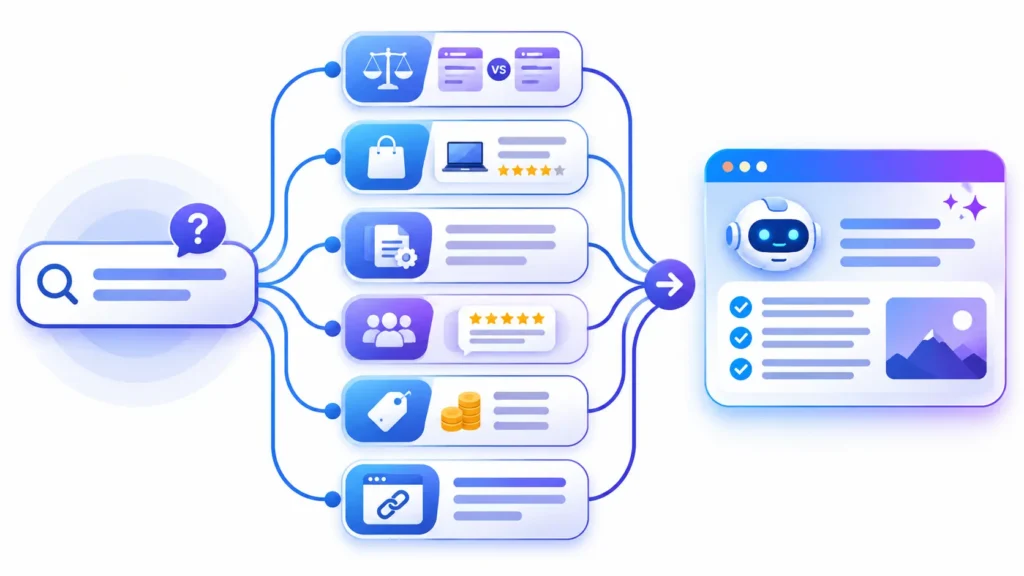
Google confirms that both AI Mode and AI Overviews can use query fan-out to investigate related searches across different subtopics and information sources.
Retrieving information from the web
Google AI Mode relies on Google’s broader search infrastructure to retrieve relevant information from the web.
One important technology involved in generative search is retrieval-augmented generation (RAG). RAG uses information retrieved from external sources to ground generated responses in relevant and current information.
Google explains that its generative search experiences use information from its Search index and existing ranking and quality systems to identify relevant webpages.
This means that website accessibility, indexing, content relevance, and information quality remain important considerations.
A website does not need to publish a separate AI version of every article to become eligible for AI-powered search experiences.
Generating the response
After gathering relevant information, AI Mode generates a consolidated answer based on the user’s original question and the information retrieved.
Depending on the topic, the response may include explanations, comparisons, recommendations, lists, or interactive elements.
The generated response may combine information from several websites rather than reproduce one source in its entirety.
Displaying supporting website links
Google AI Mode can include links to webpages that support different parts of its response.
These links allow users to investigate original information, read detailed explanations, compare products, and verify important claims.
A website may therefore become relevant to one specific part of a broader AI-generated response, even if the original question does not directly contain its primary keyword.
However, appearing as a supporting source is not guaranteed. Relevance to the specific question and Google’s automated systems influence which links are displayed.
Important distinction: Query fan-out is a documented Google search technique. The exact internal ranking, source-selection, and response-generation mechanisms are not fully disclosed publicly.
3. Key Features of Google AI Mode
Google AI Mode combines conversational interaction, multimodal search, and advanced AI capabilities within Google Search.
Its available functionality continues to evolve, so the exact experience may differ according to the user’s country, account, device, and feature availability.
Conversational Search
Conversational search allows users to explore a topic through a continuing discussion rather than submitting unrelated searches.
For example, someone researching cloud hosting can initially ask about available solutions and then follow up with questions about security, scalability, server locations, and pricing.
The system can use the context of the ongoing conversation to understand subsequent questions.
This is particularly useful when the original information requirement involves several connected decisions.
Follow-Up Questions
Users can ask additional questions without reconstructing the entire original request.
For example, after comparing three CRM platforms, someone might ask:
“Which of these platforms offers the strongest automation features?”
They could then continue:
“Compare their integration capabilities with HubSpot and explain which one would be easier for a small sales team to implement.”
This makes AI Mode useful for research that develops through multiple stages.
Multimodal Search
Multimodal search allows users to provide information through different input formats rather than relying exclusively on text.
Depending on the available experience, Google AI Mode supports:
- Text-based questions.
- Voice input.
- Image uploads.
- File uploads.
For example, a user can submit an image of a computer component and ask about its compatibility with a particular motherboard.
A professional can also provide a document or image as context for a more specific question.
This capability makes search more flexible because users can investigate information they already possess instead of describing everything manually.
Advanced Reasoning and Comparisons
Google AI Mode is designed to handle questions involving several conditions and connected decisions.
A user comparing business software may need to evaluate price, functionality, usability, integrations, and scalability together.
Rather than opening separate search results for each requirement, users can ask AI Mode to organize the comparison into one response.
The system can make research more convenient, although users should verify important recommendations against original product documentation, independent reviews, and current pricing information.
Interactive Visual Experiences
Google AI Mode can generate interactive experiences for certain questions.
These may include charts, diagrams, simulations, and interactive models that allow users to manipulate variables through sliders and other controls.
For example, someone learning about compound interest could request an interactive calculator that demonstrates how different investment amounts and interest rates affect future returns.
This approach can make complex information easier to understand than a conventional text response.
Google’s documentation describes these interactive visual experiences as available to signed-in users in supported English-language experiences. Availability may change as the product develops.
AI Mode History
Google AI Mode includes a history experience that allows users to revisit previous conversations and continue exploring earlier subjects.
This is useful for ongoing research because users do not need to repeat the entire original question every time they return to a topic.
The feature supports a more continuous research experience across connected questions.
Personal Intelligence
Google has introduced Personal Intelligence capabilities within AI Mode for eligible users.
Where available and enabled, these capabilities can use relevant information from a user’s Google Search Services history to provide more personalized suggestions.
For example, previous searches and saved preferences may help tailor certain recommendations.
However, personalization depends on account eligibility, settings, and available features. It should not be assumed that every AI Mode response is personalized.

4. Google AI Mode vs. AI Overviews vs. Traditional Search
Google AI Mode, AI Overviews, and traditional Google Search are connected experiences, but they serve different information needs.
AI Overviews provide AI-generated summaries within standard search results. AI Mode offers a more conversational interface for deeper exploration, while traditional search presents the familiar collection of ranked webpages.
Key Differences
| Feature | Traditional Google Search | AI Overviews | Google AI Mode |
| Main interface | Search results | AI summary within Search | Conversational AI interface |
| Main purpose | Discover webpages | Understand a topic quickly | Explore complex questions |
| Interaction | Individual queries | Search with AI summary | Follow-up conversations |
| Comparisons | Manual research | Shorter summarized comparisons | More detailed exploration |
| Supporting links | Ranked search listings | Links alongside summaries | Links supporting generated responses |
| Query fan-out | Not a user-facing feature | May use query fan-out | May use query fan-out |
| Best use case | Finding specific websites | Quick explanations | Research and decision-making |
When should users choose each experience?
Traditional Google Search: Useful when someone already knows what they want and needs direct access to a particular website, official document, product, or service.
AI Overviews: Useful when someone wants a quick explanation or summary while remaining within the standard search results interface.
Google AI Mode: Useful when a question requires comparisons, several research steps, follow-up questions, or exploration of connected subjects.
The three experiences are not completely independent products. They use elements of Google’s wider search infrastructure, but their interfaces, models, and response-generation approaches can differ.
5. How to Access and Use Google AI Mode
Google AI Mode is available in supported countries, languages, and accounts through Google Search.
As of November 18, 2026, India is included in Google’s supported-country documentation. Access and specific features may still vary according to account and product availability.
Accessing Google AI Mode on a Computer
- Visit https://www.google.com/ai.
- Sign in to your Google Account if required.
- Enter a question in the AI Mode input field.
- Review the generated answer and supporting links.
- Ask follow-up questions to explore the subject further.
Users can also visit Google Search, enter a question, and select AI Mode where the option is available.
Accessing Google AI Mode on Mobile
- Open the Google app or a supported mobile browser.
- Access Google Search.
- Select the AI Mode option where available.
- Enter a question using text or voice.
- Continue the conversation through relevant follow-up questions.
Google’s Search Help documentation provides the latest access instructions for desktop and mobile devices.
How to Write Better AI Mode Queries
A useful AI Mode query should explain what the user wants to accomplish rather than simply naming a broad subject.
For example:
Basic query:
“Best CRM software?”
More useful query:
“Compare CRM platforms for a small B2B sales team of eight people. Prioritize lead management, email integrations, reporting, automation, and affordability. Explain the main advantages and limitations of the leading options.”
The second query provides context and specific evaluation criteria.
A useful question generally includes:
- The main subject.
- The user’s objective.
- Relevant constraints.
- Comparison criteria.
- The preferred format of the response, when necessary.
Follow-up questions can then focus on missing details rather than repeating the entire original request.
6. How Google AI Mode Affects SEO
Google AI Mode changes how users discover information and interact with websites through Google Search.
For SEO professionals, the challenge is no longer limited to obtaining visibility in conventional search listings. Websites must also understand how their content can support more complex, AI-generated search experiences.
However, an important distinction exists between Google’s confirmed recommendations and industry predictions.
Google’s official documentation states that existing SEO best practices remain relevant to AI Mode and AI Overviews. Pages must satisfy the normal technical requirements for Google Search, and no additional technical requirements or special AI-specific optimizations are necessary for eligibility.
Search Visibility Extends Beyond Traditional Rankings
A webpage can potentially appear as a supporting source in an AI-generated response, even when the original question is more complex than a conventional keyword search.
Query fan-out allows Google to explore related subtopics and identify relevant webpages that address different aspects of a user’s information requirement.
For example, an article about cloud security may support one part of a broader question comparing cloud hosting providers.
This creates opportunities for websites that publish detailed resources addressing specific user needs.
However, traditional rankings and AI search appearances should not be treated as interchangeable metrics.
Zero-Click Searches and Organic Traffic
One major concern surrounding AI-powered search is the possibility that users will receive sufficient information directly within Google’s interface without visiting the websites that contributed to the answer.
This may affect simple informational searches where users only need a definition, short explanation, or basic factual response.
However, the effect will not necessarily be identical across industries and search intents.
Someone looking for a basic explanation of cloud computing may be satisfied with an AI-generated response. A business owner comparing enterprise hosting providers may still need to visit several websites before making a purchasing decision.
The actual traffic impact should therefore be measured rather than assumed.
Click Quality Becomes More Important
Traffic volume alone does not provide a complete picture of SEO performance.
A smaller number of visitors with strong purchasing intent may generate more business value than a much larger audience looking for basic information.
Businesses should evaluate:
- Qualified organic sessions.
- Lead submissions.
- Product purchases.
- Subscription registrations.
- Engagement with important landing pages.
- Revenue attributed to organic discovery.
The objective should be to understand whether search visibility attracts relevant audiences rather than simply increasing website visits.
Topical Authority Becomes More Strategically Valuable
Complex search questions frequently involve several connected subjects.
A website publishing one isolated article about cybersecurity may have limited subject coverage compared with a publisher offering detailed resources about network security, encryption, endpoint protection, threat detection, and incident response.
However, publishing more articles does not automatically establish topical authority.
Each supporting resource should address a distinct information requirement and provide meaningful value.
For a deeper explanation, see VIX Premium’s guide to what topical authority means for SEO.
Original Expertise Becomes a Stronger Differentiator
AI systems can summarize information already available across the web.
Consequently, content that simply repeats commonly available explanations offers limited differentiation.
Original research, documented product testing, technical analysis, expert commentary, and detailed implementation examples provide more substantial value.
For example, a software review containing an actual testing methodology, screenshots, performance observations, and documented limitations offers information that a generic list of product features cannot replace.
Google’s generative AI optimization guidance also emphasizes valuable, unique, non-commodity content.
Search Reporting Requires a Broader Approach
Traditional SEO reporting often focuses on impressions, clicks, rankings, and organic sessions.
AI-powered search introduces additional questions about how frequently a website appears as a supporting source and which pages receive visibility within AI-generated responses.
Google introduced dedicated Generative AI Performance Reports in Search Console in June 2026. The reports were rolled out worldwide on August 31, 2026.
These reports provide information about impressions from generative AI features, including AI Overviews and AI Mode.
Website owners can analyze performance by:
- Pages.
- Countries.
- Devices.
- Dates.
This provides a more direct way to evaluate visibility within Google’s generative search experiences.
Publishers Have More Control Over AI Search Inclusion
Another important development is Google’s Search generative AI control.
Available through Search Console, this setting allows website owners to manage whether their content can appear in supported generative AI features, including AI Overviews and AI Mode.
The available options include:
- Include the site’s links and content in Search generative AI features.
- Exclude the site’s links and content from these features.
- Inherit the setting from a parent property.
The default control for properties without a parent override is inclusion.
Excluding a website prevents its content from appearing as supporting links or being used to ground responses in the affected generative AI experiences. Google states that this control does not function as a ranking signal for other parts of Search.
This is particularly relevant for publishers evaluating their participation in AI-powered search.
Expert recommendation: Before changing this setting, evaluate its implications for website visibility, referral traffic, and content distribution. Do not treat it as a routine SEO optimization toggle.
7. How to Optimize Your Website for Google AI Mode
There is no guaranteed technique for making a website appear in Google AI Mode.
Google’s official recommendations emphasize established SEO fundamentals, technical accessibility, helpful content, and compliance with Search policies.
The following practices provide a practical framework for improving website quality and search accessibility.
Build Content Around Genuine User Needs
Start with the questions your audience actually wants answered.
Keyword research helps identify search demand, but content planning should also examine the underlying information requirements behind those searches.
For example, website migration involves several connected subjects:
- Migration planning.
- URL structure.
- Redirect implementation.
- Canonical tags.
- Crawlability.
- Indexing.
- Traffic monitoring.
A useful resource should explain how these elements relate to one another rather than simply repeating the primary keyword.
Publish Original and Valuable Information
Originality should be a measurable editorial objective.
Before publishing an article, ask what it contributes that readers cannot easily obtain from other websites covering the same subject.
Useful contributions include:
- First-hand product testing.
- Original survey findings.
- Detailed technical examples.
- Expert commentary.
- Documented comparisons.
- Unique troubleshooting guidance.
- Real implementation scenarios.
If a subject is already widely covered, the strongest opportunity may be a more practical explanation or a genuinely useful comparison.
Organize Information with Clear Content Architecture
A well-structured webpage makes information easier to understand for both readers and search systems.
Use descriptive headings, logical sections, and meaningful relationships between related concepts.
For example, an article about technical SEO could organize its discussion around crawling, indexing, rendering, canonicalization, and structured data.
Each section should answer a clear question and provide enough context to explain the subject independently.
Write Clear, Evidence-Based Explanations
Important sections should begin with a direct explanation before moving into deeper analysis.
For example:
“Canonicalization is the process of identifying a preferred URL among multiple URLs containing duplicate or substantially similar content. It helps search engines understand which version of a webpage should be treated as the primary version.”
The explanation can then be followed by technical details, implementation examples, and limitations.
This improves readability without requiring artificial keyword repetition or unnecessary formatting.
Strengthen Internal Linking
Internal links help search engines discover webpages and understand relationships between different resources.
They also provide readers with a practical way to investigate supporting topics.
A technology publication, for example, can connect its main AI search guide with resources about GEO, AI-powered SEO, topical authority, and other search engines.
Use descriptive anchor text that explains what readers will find on the destination page.
For additional guidance, explore VIX Premium’s beginner’s guide to optimizing content for GEO.
Maintain Strong Technical SEO
Content quality cannot compensate for serious crawling or indexing problems.
Review the technical elements that determine whether Google can access and understand important webpages.
| Technical Area | Recommended Action |
| Robots.txt | Check that important content is not unintentionally blocked |
| XML sitemap | Include canonical, indexable URLs |
| Internal links | Make important pages discoverable |
| Canonical tags | Identify preferred versions of duplicate pages |
| JavaScript rendering | Ensure important content is accessible |
| Mobile experience | Maintain usability across devices |
| Structured data | Use accurate markup that reflects visible content |
| Page experience | Address usability and performance issues |
A webpage that cannot be accessed or indexed appropriately is unlikely to become a supporting source in AI-powered search.
Use Relevant Images and Videos
Visual information can make complex explanations easier to understand.
Original screenshots, product demonstrations, diagrams, and instructional videos provide useful context that a text-only explanation may not communicate effectively.
For instance, an article explaining Google Search Console should include relevant screenshots when they help readers understand the reporting interface.
Use descriptive image filenames and appropriate alternative text. Avoid adding unrelated images simply to increase the number of media elements on a webpage.
Keep Information Accurate and Updated
AI-powered search frequently handles subjects where information changes quickly.
Pricing, product features, software compatibility, regulations, and platform documentation should be reviewed regularly.
Where a statement depends on a particular version or date, provide that context.
For technology publications, a documented content review process is more useful than changing publication dates without reviewing the actual information.
Implement Structured Data Correctly
Structured data helps search engines interpret information about webpages and their content.
Depending on the subject, relevant Schema.org types may include:
- Article.
- BlogPosting.
- Product.
- Organization.
- SoftwareApplication.
- BreadcrumbList.
Use only the types and properties that accurately describe the visible content.
Google does not require special AI-specific schema markup for inclusion in AI Mode or AI Overviews. Structured data should support accurate content understanding rather than be treated as a shortcut to AI visibility.
Develop a Recognizable Subject-Matter Identity
A website should clearly communicate what it covers, who produces its content, and why readers should consider its information reliable.
Useful elements include:
- Author biographies.
- Transparent editorial standards.
- Clear review methodologies.
- References to original documentation.
- Accurate company information.
- Consistent subject coverage.
These elements help readers evaluate the credibility of the information they encounter.

8. Common AI Search Optimization Mistakes
The growing interest in GEO and AI search has created several optimization claims that are not supported by Google’s official requirements.
Understanding these misconceptions helps businesses avoid unnecessary technical work and ineffective content strategies.
Treating GEO as a Replacement for SEO
Generative Engine Optimization can be a useful framework for understanding visibility in AI-powered search experiences.
However, abandoning technical SEO, content quality, and established search practices in favor of unverified AI optimization techniques is not supported by Google’s guidance.
Google explicitly confirms that foundational SEO practices remain relevant to its generative search features.
For a broader comparison, read VIX Premium’s article on how GEO differs from traditional SEO.
Creating Unnecessary AI-Specific Files
Some marketers recommend creating files such as llms.txt as a requirement for appearing in Google’s AI search experiences.
Google does not require website owners to create these files to become eligible for AI Overviews or AI Mode.
Such files may serve other purposes in particular environments, but they should not be presented as mandatory Google SEO requirements.
Publishing Mass-Produced AI Content
Using AI to assist content production is not automatically against Google’s policies.
The problem arises when websites publish large volumes of low-value content primarily to manipulate search rankings rather than help readers.
AI-assisted content should undergo proper research, factual verification, editorial review, and meaningful improvement before publication.
Repeating Entities Unnaturally
Mentioning a company, product, technology, or person repeatedly does not automatically make a webpage more authoritative.
Entity references should be included when they help explain the subject or establish meaningful relationships.
Natural context is more useful than artificial repetition.
Assuming AI Citations Guarantee Business Results
A webpage appearing as a supporting source does not necessarily generate traffic, leads, or purchases.
Businesses should evaluate AI search visibility alongside user intent, the quality of the destination page, and the actions visitors take after arriving.
Confusing Structured Data with Guaranteed Inclusion
Schema markup can help search engines understand webpage content, but valid structured data does not guarantee selection as an AI source.
Technical eligibility, information relevance, content quality, and Google’s automated systems all influence how webpages appear in Search.
9. How to Measure Google AI Mode Performance
Measuring AI search performance requires more than checking whether a website appears in an occasional AI-generated response.
A practical reporting framework should connect visibility with website engagement and business outcomes.
Use Google Search Console’s Generative AI Performance Report
Google introduced its dedicated Generative AI Performance Report in Search Console in 2026.
As of August 31, 2026, the report has been rolled out worldwide to websites that meet Google’s reporting requirements.
It provides information about impressions generated through supported AI search experiences, including:
- AI Overviews.
- AI Mode.
Website owners can analyze the information through different dimensions.
| Dimension | What It Shows |
| Pages | URLs receiving AI search impressions |
| Countries | Countries generating impressions |
| Devices | Desktop, mobile, and tablet visibility |
| Dates | Performance over selected time periods |
The report helps publishers identify which pages receive visibility in generative AI search experiences and how that visibility changes over time.
If the report is unavailable for a website, Google explains that insufficient impression data may be the reason.
Understand AI Search Impressions
AI search impressions indicate how frequently links to a website are shown within supported generative AI experiences.
They should not be interpreted as equivalent to website visits.
A page can receive visibility within an AI-generated response without generating a click. Therefore, impressions and referral traffic should be evaluated separately.
Analyze Website Traffic with Google Analytics 4
Google Analytics 4 can help businesses understand what visitors do after reaching their websites.
Useful metrics include:
- Organic sessions.
- Engaged sessions.
- Engagement rate.
- Lead submissions.
- Purchases.
- Revenue.
- Landing-page conversions.
Referral traffic from identifiable AI search sources can also be analyzed where the available attribution data allows it.
However, not every AI-assisted discovery journey produces a clearly identifiable referral source. Attribution should therefore be interpreted carefully.
Track Relevant Search Topics
Develop a list of important questions and subjects connected to your products, services, and expertise.
Monitor the organic performance of relevant webpages and investigate how they appear in AI search experiences.
Manual searches can provide qualitative insights, but individual observations should not be treated as reliable visibility metrics because results may vary according to the question, location, user context, and time.
Measure Business Outcomes
The ultimate purpose of search visibility is to attract the right audience and support meaningful business results.
A practical reporting dashboard should include:
| Measurement Area | Example Metric | Purpose |
| AI visibility | Generative AI impressions | Understand source exposure |
| Organic search | Clicks and impressions | Monitor conventional search |
| Engagement | Engaged sessions | Evaluate visitor interest |
| Lead generation | Qualified enquiries | Measure commercial relevance |
| Ecommerce | Purchases and revenue | Evaluate sales contribution |
| Content performance | Conversions by landing page | Identify valuable resources |
Expert recommendation: Avoid treating AI visibility as an isolated SEO KPI. Evaluate it alongside traditional search performance, referral traffic, engagement, and business conversions.
For practical workflows involving AI-assisted optimization, see VIX Premium’s guide on how to use AI for SEO.
10. Google AI Mode and the Future of Search
Google AI Mode illustrates a broader transition from keyword-based information retrieval toward conversational and context-aware search experiences.
People can describe more complex information needs, provide additional context, and refine their questions through follow-up interactions.
This creates opportunities for websites that provide detailed, trustworthy, and genuinely useful information.
It also creates challenges for publishers whose business models depend heavily on visits generated by simple informational searches.
Three developments deserve particular attention.
More Complex Search Behaviour
Users can combine several requirements into one question rather than performing multiple short searches.
Content strategies should account for these connected information needs while maintaining clear coverage of individual subjects.
A comprehensive resource should answer the main question and provide meaningful supporting explanations.
Greater Importance of Original Resources
As AI systems summarize widely available information, original research, technical documentation, expert analysis, and first-hand experience can provide meaningful differentiation.
Publishers should prioritize information that adds value beyond what can be reconstructed from commonly available sources.
A Changing Relationship Between Search Visibility and Website Traffic
Being visible in a search experience and receiving a website visit are two different outcomes.
Publishers will need to monitor both while improving their ability to turn qualified visitors into subscribers, customers, leads, and returning readers.
The long-term effects of AI search on traffic distribution, advertising, and publisher economics are still developing.
Businesses should adapt using measurable evidence rather than assuming every industry will experience the same changes.
Frequently Asked Questions
What is Google AI Mode?
Google AI Mode is an AI-powered search experience within Google Search that generates conversational responses to complex questions. It allows users to explore topics, ask follow-up questions, and access supporting links from relevant websites.
How does Google AI Mode work?
Google AI Mode interprets a user’s question, explores related searches through query fan-out, and retrieves relevant information from the web. It then generates a consolidated response with supporting links where appropriate.
Is Google AI Mode free to use?
Google provides AI Mode as part of its Search experience, although certain advanced models or features may have account, subscription, or usage requirements. Availability and access conditions can vary by country and feature.
What is the difference between Google AI Mode and AI Overviews?
AI Overviews provide AI-generated summaries within conventional Google Search results. AI Mode offers a dedicated conversational experience that supports deeper exploration, follow-up questions, and more complex comparisons.
Does Google AI Mode affect traditional SEO?
Yes, it can influence how users discover information and interact with websites through Google Search. However, Google confirms that foundational SEO practices remain relevant and that no additional special optimization is required for inclusion in AI Mode.
How can a website appear in Google AI Mode?
A website should have indexable pages that meet Google’s technical requirements and provide helpful, reliable, original information. Strong internal linking, clear content structure, and technical accessibility can support eligibility, although inclusion is never guaranteed.
Does Google AI Mode use Gemini?
Google’s AI Mode uses Google’s AI models and search technologies to interpret questions and generate responses. Google identifies its Gemini model family as part of the technology behind its AI search experiences, although the specific models and capabilities can change as the product develops.
What is query fan-out in Google AI Mode?
Query fan-out is a process through which Google’s AI search systems explore multiple related searches across different subtopics and information sources. It helps the system gather information needed to answer complex questions rather than relying on one search query.
Does Google require special GEO optimization for AI Mode?
No. Google does not require special GEO techniques, AI-specific schema markup, or additional AI text files for inclusion in AI Mode. Its official recommendations emphasize established SEO fundamentals and helpful, people-first content.
How can businesses track Google AI Mode visibility?
Businesses can use Google Search Console’s Generative AI Performance Report to monitor impressions from AI Mode and AI Overviews. Google Analytics 4 can help evaluate organic sessions, engagement, leads, purchases, and other business outcomes.
Conclusion
Google AI Mode is changing the search experience by allowing users to investigate complex questions through conversational interactions and AI-generated responses. Its ability to explore related searches and provide supporting website links creates new opportunities for publishers while raising legitimate questions about referral traffic and the future of organic discovery.
For SEO professionals, the most sustainable response is to strengthen the foundations that already make websites useful and accessible. Technical SEO, original content, clear information architecture, reliable references, and a strong understanding of audience needs remain central to search visibility.
Rather than chasing unverified GEO shortcuts, businesses should focus on becoming genuinely useful sources of information. That approach supports both traditional organic search and the evolving AI-powered experiences within Google Search.
External References
- Google Search Central – AI Features and Your Website
https://developers.google.com/search/docs/appearance/ai-features - Google Search Help – Get AI-Powered Responses with AI Mode
https://support.google.com/websearch/answer/16011537 - Google Search Central – Optimizing Your Website for Generative AI Features
https://developers.google.com/search/docs/fundamentals/ai-optimization-guide - Google Search Console – Generative AI Performance Report
https://support.google.com/webmasters/answer/16984139 - Google Search Console – Search Generative AI Control
https://support.google.com/webmasters/answer/16908024 - Google Search Central – New Resource for Optimizing for Generative AI in Google Search
https://developers.google.com/search/blog/2026/05/a-new-resource-for-optimizing