Artificial intelligence is shifting from systems that simply answer questions to software capable of planning tasks, using tools, remembering context, and completing work with minimal human intervention. These systems are commonly called AI agents, and they are becoming an important part of modern software development, business operations, and personal productivity.
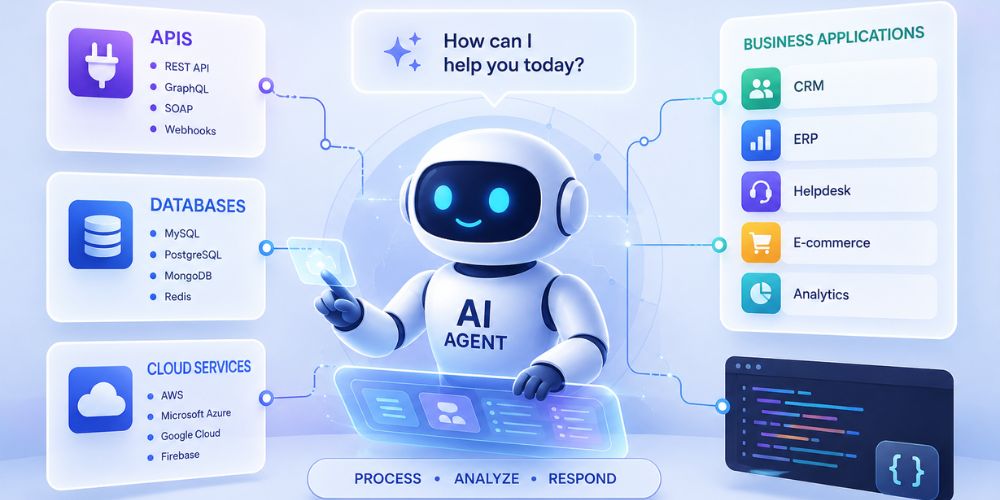
Unlike a traditional chatbot that responds only after receiving a prompt, an AI agent can evaluate a goal, break it into smaller steps, gather information, interact with external applications, and adjust its actions based on new information. This capability makes AI agents useful for repetitive processes, customer support, coding assistance, research, and workflow automation.
Whether you are a business owner exploring automation, a developer building intelligent applications, or a professional trying to understand the next stage of artificial intelligence, this guide explains how AI agents work, the different types available, where they are used, and what limitations to consider before adopting them.
What Are AI Agents?
Short answer: An AI agent is an intelligent software system that can perceive information, reason about a goal, make decisions, and perform actions with limited human supervision.
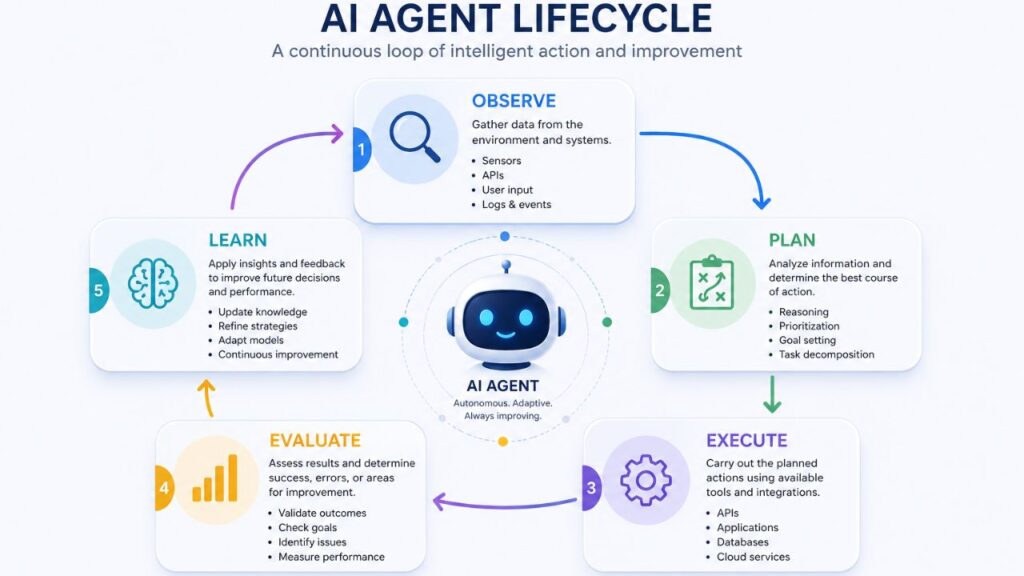
Instead of generating a single response to a prompt, an AI agent operates through a continuous cycle of observation, planning, execution, and evaluation. It can access external tools, retrieve information from databases, interact with APIs, and modify its approach when new data becomes available.
For example, if you ask an AI chatbot to summarize a research paper, it typically responds with text based on the content you provide. An AI agent, however, could search for the paper, download it, summarize key findings, compare them with related studies, organize the results into a report, and send the finished document to your email—all as part of a single objective.
This ability to carry out multiple coordinated actions is what distinguishes AI agents from conventional conversational AI.
Original Insight #1: Many organizations believe they need fully autonomous AI agents, but most productivity gains come from “human-in-the-loop” agents that require approval before performing sensitive actions. This approach reduces operational risk while preserving the efficiency benefits of automation.
How AI Agents Work
Short answer: AI agents follow a decision-making loop that combines perception, reasoning, action, and feedback to accomplish specific objectives.
Although implementations differ, most AI agents rely on a common operational cycle.
| Stage | Purpose |
| Observe | Collect information from users, sensors, databases, or APIs |
| Interpret | Understand the current situation using an AI model |
| Plan | Decide the sequence of actions required |
| Execute | Use software tools or services to perform tasks |
| Evaluate | Check whether the goal has been achieved |
| Improve | Adjust future actions using memory or feedback |
Rather than treating every interaction as an isolated prompt, AI agents maintain context throughout a workflow. This enables them to revisit previous decisions, request additional information when necessary, and adapt to changing conditions.
For example, a customer support agent may identify a user’s issue, search a knowledge base, verify account information, create a support ticket, and draft a personalized response. If any required information is missing, the agent can pause the workflow and request clarification before continuing.
This continuous feedback loop makes AI agents more suitable for complex, multi-step tasks than traditional conversational systems.
Core Components of an AI Agent
Most AI agents combine several specialized components that work together to complete tasks effectively.
| Component | Function |
| Large Language Model | Understands instructions and generates reasoning |
| Memory | Stores previous interactions and contextual information |
| Planning Module | Breaks complex goals into smaller tasks |
| Tool Integration | Connects with APIs, databases, browsers, or software |
| Decision Engine | Determines the next action based on available information |
| Feedback System | Evaluates outcomes and improves future performance |
Not every AI agent includes all of these components, but more advanced implementations typically combine them to support autonomous decision-making and long-running workflows.
One emerging trend is the use of standardized protocols that allow AI agents to interact with external tools more consistently. Frameworks such as the Model Context Protocol (MCP) are helping developers create interoperable systems that can access applications, databases, and services without requiring custom integrations for every use case.
Types of AI Agents
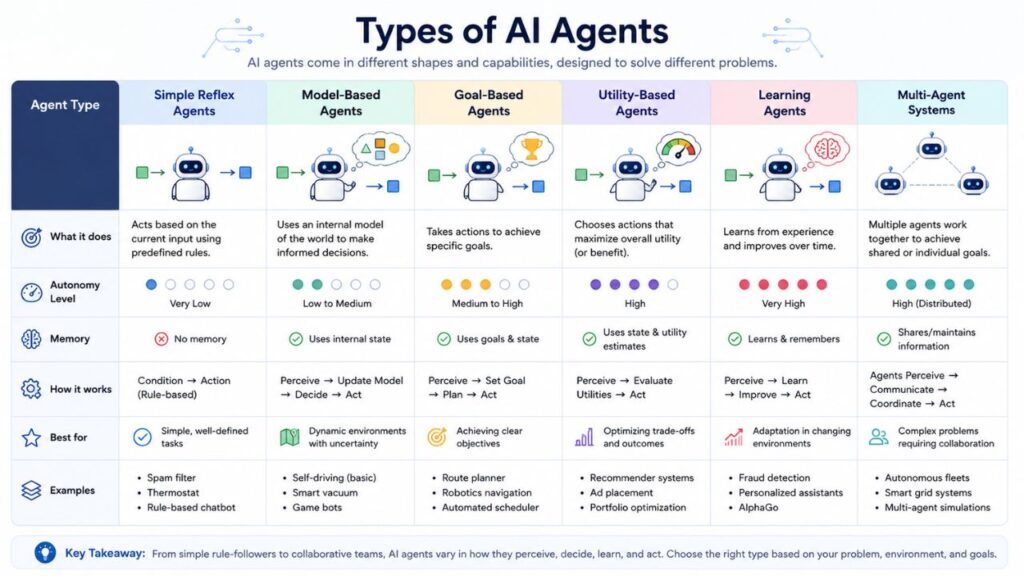
Short answer: AI agents can be categorized by how they make decisions, use memory, pursue goals, and collaborate with other systems. The appropriate type depends on the complexity of the task and the level of autonomy required.
While many articles list agent types as separate concepts, modern AI platforms often combine several of these approaches in a single system. For example, an enterprise customer support agent may use memory, planning, external tools, and collaboration with other specialized agents.
The table below summarizes the most common types of AI agents.
| AI Agent Type | Description | Typical Use Cases |
| Simple Reflex Agent | Responds to predefined rules without memory | Basic automation, rule-based support |
| Model-Based Reflex Agent | Maintains an internal understanding of the environment | Monitoring systems, diagnostics |
| Goal-Based Agent | Plans actions to achieve a defined objective | Travel planning, research assistants |
| Utility-Based Agent | Chooses actions that maximize a preferred outcome | Resource optimization, pricing |
| Learning Agent | Improves performance using experience and feedback | Recommendation systems, fraud detection |
| Autonomous AI Agent | Operates with minimal human intervention while using tools and memory | Workflow automation, software development |
| Multi-Agent System | Multiple AI agents cooperate to solve complex problems | Enterprise operations, software engineering |
Simple Reflex Agents
Short answer: Simple reflex agents react to specific inputs using predefined rules without considering past interactions.
These agents work well in predictable environments where every situation has a clear response. A thermostat that activates heating when the temperature drops below a threshold follows the same fundamental principle, although it is not powered by a large language model.
Because they have no memory or planning capability, reflex agents are inexpensive to build but unsuitable for tasks requiring reasoning or adaptation.
Model-Based Reflex Agents
Short answer: Model-based agents maintain an internal representation of their environment to make more informed decisions.
Instead of responding only to current inputs, these agents consider previous observations to understand what has changed. This additional context allows them to handle situations where not all information is immediately visible.
For example, a warehouse monitoring system may track inventory movement throughout the day rather than responding only to a single barcode scan.
Goal-Based AI Agents
Short answer: Goal-based agents determine the sequence of actions required to achieve a specific objective.
Rather than executing fixed rules, they evaluate multiple possible paths before deciding what to do next. This planning capability makes them suitable for research assistants, scheduling tools, and autonomous coding assistants.
Suppose a user requests a competitor analysis. A goal-based AI agent may search company websites, collect pricing information, summarize product features, generate comparison tables, and produce a final report without requiring separate prompts for each step.
Utility-Based Agents
Short answer: Utility-based agents evaluate multiple possible outcomes and select the option with the highest overall value.
Unlike goal-based systems that simply achieve an objective, utility-based agents optimize for factors such as speed, cost, accuracy, or customer satisfaction. Businesses often use this approach for logistics, pricing optimization, and resource allocation.
For example, an AI delivery planner may calculate several shipping routes before selecting the one that minimizes both delivery time and fuel consumption.
Learning Agents
Short answer: Learning agents improve their performance by analyzing previous results and incorporating feedback.
These systems become more effective over time because they recognize successful patterns and avoid repeating ineffective actions. Recommendation engines used by streaming platforms and e-commerce websites are common examples of learning agents.
Organizations deploying learning agents should regularly review training data and performance metrics to reduce bias and maintain reliable outcomes.
Autonomous AI Agents
Short answer: Autonomous AI agents perform multi-step tasks with limited human supervision while adapting to changing conditions.
Unlike conversational assistants that wait for each instruction, autonomous agents can decide which tools to use, gather additional information, revise their plans, and continue working until the objective is complete.
Examples include:
- Automated software testing
- Security monitoring
- AI-powered financial reporting
- Research assistants
- Customer onboarding
- Intelligent document processing
- Marketing campaign optimization
Although autonomous AI agents reduce manual effort, organizations typically implement approval checkpoints before allowing them to execute sensitive actions such as deleting files, transferring funds, or modifying production systems.
Original Insight #2: The most successful enterprise AI deployments are rarely fully autonomous. Instead, they use progressive autonomy, where agents handle routine work independently but require human approval for high-impact decisions. This balance improves efficiency without sacrificing governance or accountability.
Multi-Agent Systems
Short answer: Multi-agent systems divide complex tasks among several specialized AI agents that collaborate toward a shared objective.
Each agent focuses on a different responsibility, such as planning, coding, reviewing, researching, or quality assurance. A coordinating agent manages communication and combines the results into a final output.
For example, a software development workflow could involve:
| Agent | Responsibility |
| Planner | Defines project requirements |
| Research Agent | Collects technical documentation |
| Developer Agent | Generates application code |
| Testing Agent | Executes automated tests |
| Review Agent | Identifies bugs and suggests improvements |
| Documentation Agent | Produces technical documentation |
This collaborative approach often produces higher-quality results than relying on a single general-purpose agent.
AI Agents vs AI Assistants vs AI Chatbots
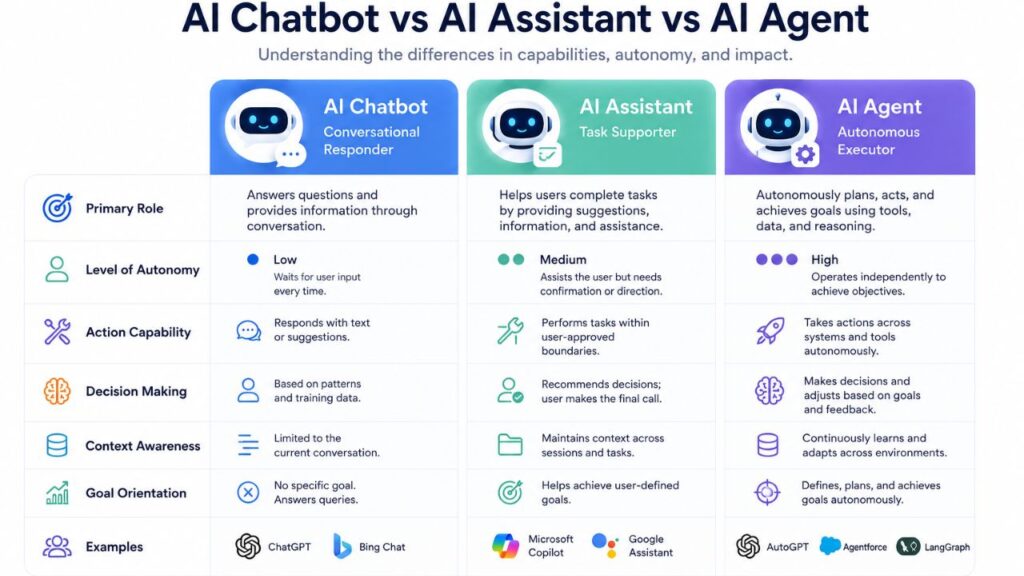
Short answer: Although the terms are often used interchangeably, AI agents, AI assistants, and chatbots serve different purposes and offer different levels of autonomy.
Understanding these distinctions helps organizations choose the right technology for their needs rather than assuming every conversational AI product functions as an autonomous agent.
| Feature | AI Chatbot | AI Assistant | AI Agent |
| Conversational Interface | ✓ | ✓ | ✓ |
| Answers Questions | ✓ | ✓ | ✓ |
| Uses External Tools | Limited | Yes | Extensive |
| Multi-Step Planning | No | Limited | Yes |
| Long-Term Memory | Rare | Partial | Yes |
| Autonomous Decision-Making | No | Limited | Yes |
| Executes Complex Workflows | No | Partial | Yes |
| Human Supervision Required | High | Moderate | Low to Moderate |
A customer service chatbot typically answers FAQs based on predefined information. An AI assistant, such as those integrated into productivity software, can summarize meetings, draft emails, or retrieve files. An AI agent extends these capabilities by independently planning and completing entire workflows involving multiple systems.
If you’re comparing leading conversational AI platforms, our guide on ChatGPT vs Claude AI explains how different language models support agent-based workflows and productivity scenarios.
Real-World AI Agent Examples
Short answer: AI agents are already being used across industries to automate repetitive tasks, improve decision-making, and assist professionals with complex workflows.
The examples below illustrate how organizations are applying AI agents beyond simple text generation.
Customer Support
Support agents can classify tickets, retrieve account information, recommend solutions from a knowledge base, and prepare responses before escalating complex issues to human representatives.
Software Development
Development agents assist engineers by generating code, reviewing pull requests, identifying bugs, writing documentation, and running automated tests. Tools such as Cursor AI combine conversational interfaces with integrated coding workflows to accelerate software development.
For developers interested in AI-assisted programming, see our Cursor AI Guide for a detailed overview of its capabilities.
Marketing
Marketing teams use AI agents to:
- Research competitors
- Generate campaign briefs
- Analyze keyword opportunities
- Draft social media content
- Monitor brand mentions
- Produce performance reports
When paired with human review, these workflows significantly reduce time spent on repetitive marketing tasks while maintaining editorial oversight.
Sales Operations
Sales agents can qualify leads, summarize CRM activity, schedule meetings, prepare follow-up emails, and generate account insights from customer data.
Instead of replacing sales professionals, these systems reduce administrative work and allow representatives to spend more time building customer relationships.
Cybersecurity
Security teams use AI agents to analyze system logs, investigate suspicious activity, correlate alerts from multiple monitoring tools, and recommend incident response actions.
Human analysts continue to validate critical decisions, particularly when responding to high-risk security events.
Healthcare
Healthcare organizations are experimenting with AI agents for administrative tasks such as appointment scheduling, documentation assistance, insurance verification, and clinical note summarization.
Because patient safety and privacy are essential, these systems typically operate under strict regulatory requirements and human supervision.
Finance
Financial institutions use AI agents to automate compliance checks, reconcile transactions, identify anomalies, and assist with risk analysis.
Organizations should verify regulatory requirements before deploying AI agents in financial decision-making because legal obligations vary across jurisdictions.
Original Insight #3: Many organizations expect AI agents to replace employees immediately. In practice, the highest return on investment often comes from augmenting existing teams by removing repetitive work while keeping human expertise focused on strategic decisions.
AI Workflow Automation
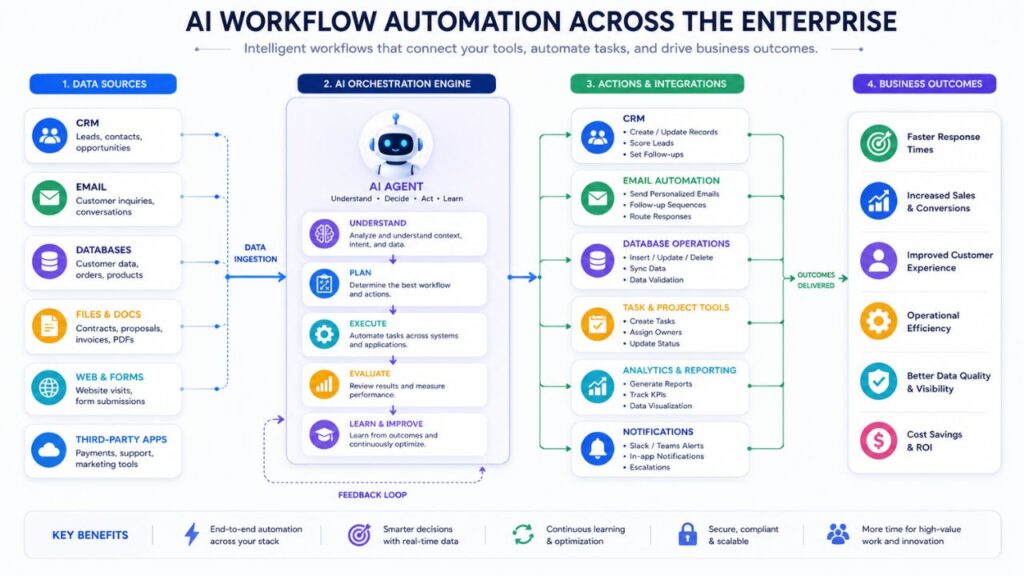
Short answer: AI workflow automation combines intelligent decision-making with software integrations to complete business processes that traditionally required manual intervention.
Unlike conventional automation tools that follow fixed rules, AI agents can interpret unstructured information, reason through exceptions, and adapt their actions based on changing inputs.
A typical AI workflow may look like this:
- Receive a customer request.
- Extract relevant information.
- Search internal documentation.
- Query external APIs.
- Generate recommendations.
- Request human approval if required.
- Complete the task.
- Record the outcome for future learning.
Businesses exploring AI-powered marketing workflows may also benefit from our guide on How to Use AI for SEO, which explains practical ways AI can support content creation, keyword research, and optimization while maintaining human oversight.
Benefits of AI Agents
Short answer: AI agents help organizations automate complex tasks, improve operational efficiency, reduce repetitive work, and support better decision-making. Their value comes from combining reasoning, planning, memory, and tool usage rather than simply generating text.
The greatest productivity gains occur when AI agents are integrated into existing workflows instead of operating as standalone tools. They can retrieve information, coordinate actions across multiple applications, and continuously adapt as new data becomes available.
Key Benefits
| Benefit | Business Impact |
| Increased productivity | Automates repetitive multi-step tasks |
| Faster decision-making | Retrieves and analyzes information quickly |
| Lower operational costs | Reduces manual effort for routine processes |
| Consistent execution | Follows standardized workflows with fewer errors |
| Continuous availability | Operates 24/7 without scheduling constraints |
| Better scalability | Handles growing workloads without proportional staffing increases |
| Improved collaboration | Connects multiple systems and departments |
Although these benefits are compelling, organizations achieve the best results by defining clear objectives and measuring outcomes rather than deploying AI agents for every process.
Challenges and Limitations of AI Agents
Short answer: AI agents are powerful but not infallible. They can make incorrect decisions, misinterpret instructions, rely on outdated information, or introduce security and compliance risks if deployed without appropriate oversight.
Understanding these limitations is essential before integrating AI agents into production environments.
Common Challenges
Hallucinations and Incorrect Outputs
Large language models occasionally generate convincing but inaccurate responses. If an AI agent uses these outputs to make decisions or execute actions, the consequences can range from minor inefficiencies to significant business risks.
Organizations should validate critical outputs through human review or rule-based verification systems.
Security Risks
AI agents often require access to company resources such as email, cloud storage, databases, APIs, and internal documentation. Excessive permissions increase the potential impact of compromised accounts or unintended actions.
Following the principle of least privilege—granting only the permissions required for a specific task—reduces security exposure.
Data Privacy
Businesses handling sensitive customer or employee information must ensure AI systems comply with applicable privacy regulations. Depending on the jurisdiction, this may include requirements related to data retention, consent, encryption, and auditability.
Always review the latest guidance from your AI provider and relevant regulatory authorities before processing confidential information.
Cost and Resource Management
Although AI can reduce operational costs, large-scale deployments may increase expenses through API usage, infrastructure requirements, and ongoing maintenance. Monitoring usage patterns and optimizing workflows helps control long-term costs.
Human Oversight
Even highly capable AI agents benefit from human supervision. Organizations should define escalation rules, approval workflows, and performance metrics before allowing agents to perform business-critical actions independently.
Best Practices for Implementing AI Agents
Short answer: Successful AI agent projects begin with clearly defined business problems, limited initial scope, and measurable success criteria.
Many organizations fail because they attempt to automate complex processes before understanding existing workflows. Starting with smaller, repeatable tasks allows teams to evaluate performance and refine governance before expanding adoption.
Implementation Checklist
- Identify repetitive processes with measurable outcomes.
- Define clear success metrics before deployment.
- Keep humans involved in high-impact decisions.
- Grant only the minimum permissions required.
- Log agent actions for auditing and troubleshooting.
- Continuously evaluate accuracy and performance.
- Regularly update prompts, tools, and integrations.
- Test workflows before deploying to production.
Expert Tip: Choose one workflow that consumes significant employee time but involves relatively low business risk. Early success builds confidence, reveals operational challenges, and provides measurable data to support broader AI adoption.
Popular AI Agent Frameworks and Platforms
Short answer: Several open-source and commercial frameworks simplify the development of AI agents by providing orchestration, memory management, tool integration, and workflow capabilities.
The best framework depends on your technical expertise, infrastructure, and application requirements.
| Framework | Best For | Open Source |
| LangChain | General AI application development | Yes |
| LangGraph | Stateful multi-step agent workflows | Yes |
| AutoGen | Multi-agent collaboration | Yes |
| CrewAI | Role-based autonomous agents | Yes |
| OpenAI Agents SDK | Applications built with OpenAI models | Yes |
| Microsoft Semantic Kernel | Enterprise AI applications | Yes |
Developers should compare documentation, licensing, ecosystem maturity, and community support before selecting a framework. Features evolve rapidly, so verify the latest capabilities through official documentation.
The Future of AI Agents
Short answer: AI agents are expected to become more capable, collaborative, and integrated with enterprise software, but human oversight will remain essential for many high-stakes applications.
Several trends are shaping the next generation of AI agents:
- Improved reasoning capabilities.
- Better long-term memory.
- Enhanced collaboration between specialized agents.
- Standardized protocols for tool integration.
- Greater enterprise adoption with governance controls.
- Native integration with productivity and business software.
- More multimodal capabilities, including text, images, audio, and video.
As organizations gain experience, AI agents will increasingly support employees by handling repetitive operational work while humans focus on strategy, creativity, relationship management, and complex decision-making.
Conclusion
AI agents represent a significant evolution in artificial intelligence, moving beyond conversational interfaces toward systems capable of planning, reasoning, and executing complex workflows. Their ability to combine language models with memory, external tools, and decision-making makes them valuable across industries ranging from software development and marketing to healthcare and finance.
Despite their capabilities, AI agents should not be viewed as fully independent replacements for human expertise. The most effective deployments combine automation with appropriate oversight, clear governance, and continuous performance evaluation. Organizations that adopt this balanced approach are more likely to achieve sustainable productivity improvements while reducing operational risk.
As AI models, orchestration frameworks, and interoperability standards continue to mature, AI agents will become a core component of modern business software. Understanding how they work today provides a strong foundation for evaluating future technologies and identifying practical opportunities for responsible adoption.
Frequently Asked Questions
1. What is an AI agent?
An AI agent is a software system that can perceive information, reason about goals, use external tools, and perform multi-step tasks with varying levels of autonomy.
2. How is an AI agent different from ChatGPT?
ChatGPT primarily generates responses to prompts, whereas an AI agent can plan tasks, use tools, maintain memory, and complete workflows independently.
3. What are autonomous AI agents?
Autonomous AI agents perform tasks with minimal human intervention by making decisions, interacting with software, and adapting to changing conditions.
4. Where are AI agents used?
Common applications include customer support, software development, marketing, cybersecurity, finance, healthcare, research, and workflow automation.
5. Are AI agents replacing jobs?
Most organizations use AI agents to automate repetitive work rather than replace employees. Human oversight remains essential for strategic and high-risk decisions.
6. Which programming languages are commonly used to build AI agents?
Python is the most widely used language due to its extensive ecosystem of AI libraries and frameworks, although JavaScript, Java, and C# are also used.
7. What frameworks help developers build AI agents?
Popular frameworks include LangChain, LangGraph, CrewAI, AutoGen, OpenAI Agents SDK, and Microsoft Semantic Kernel.
8. Can AI agents work without internet access?
Some AI agents can operate in offline environments if they have access to local models and required resources, although many rely on cloud-based services and APIs.
9. Are AI agents secure?
They can be secure when implemented with appropriate access controls, monitoring, encryption, and governance. Security depends on the deployment architecture and permissions granted.
10. What is AI workflow automation?
AI workflow automation combines artificial intelligence with software integrations to automate multi-step business processes that traditionally required manual effort.